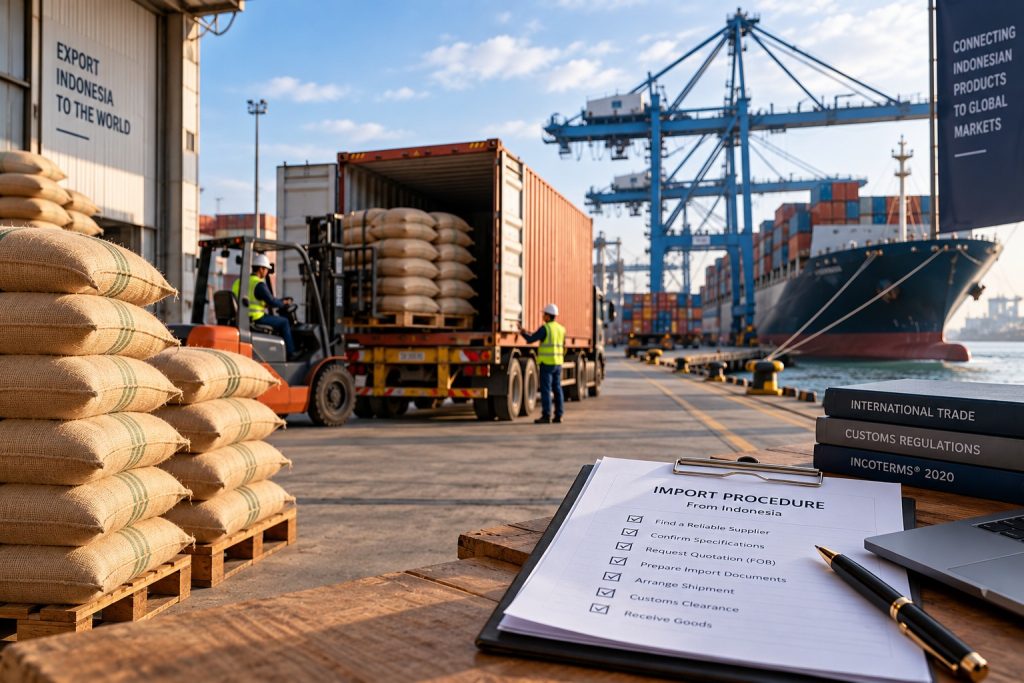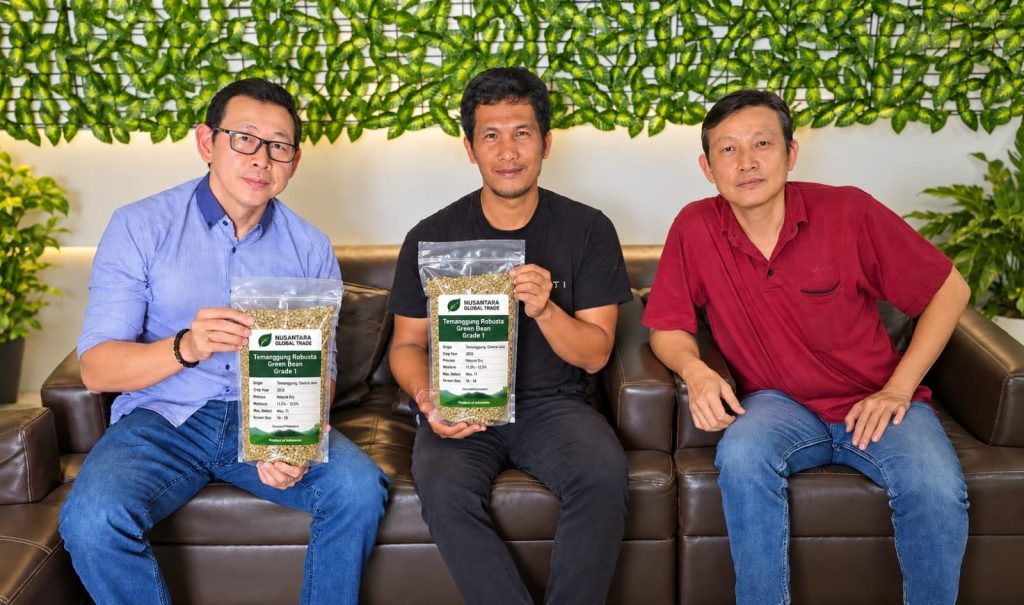
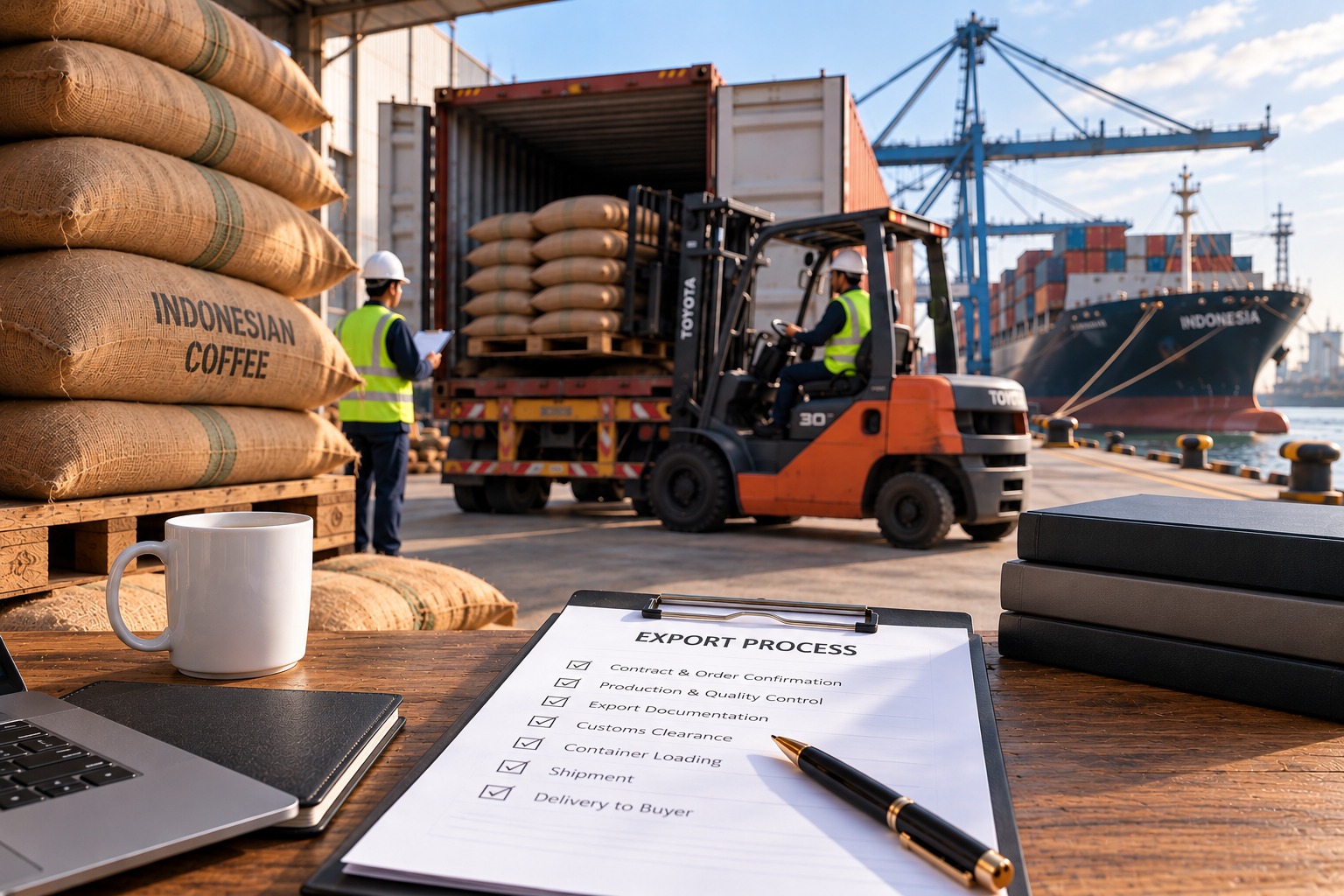
Buying green coffee beans directly from Indonesia is an attractive strategy for international coffee roasters, importers, distributors, and trading companies. However, for a first-time importer, navigating cross-border trade compliance can seem daunting.
From selecting the right origin and locking in physical specifications to handling quarantine inspections, Indonesian Customs (PEB) clearance, container stuffing, and maritime transit, each phase demands disciplined execution.
This guide explains the Indonesian coffee export process step by step, focusing specifically on commercial green coffee beans and outlining what international buyers must prepare to ensure a seamless transaction.
1. Why Buy Green Coffee Beans from Indonesia?
Indonesia maintains a celebrated coffee heritage, cultivating both Arabica and Robusta across diverse volcanic islands. For procurement teams sourcing Indonesian Robusta green coffee beans, the archipelago offers distinct regional terroirs, processing variations, and commercial specifications.
A prime sourcing origin is Central Java, specifically the volcanic plateau of Temanggung and neighboring highland belts. Indonesian Robusta is widely utilized for:
- Commercial espresso blending (high crema yield and heavy body)
- Large-scale commercial whole-bean and ground retail packs
- Soluble (instant) coffee extraction and ready-to-drink (RTD) formulations
- Specialty fine Robusta programs
- Commodity trading and warehouse distribution
Before negotiating prices, buyers must establish precise physical specifications to match their intended roast formulation.
2. Step 1 — Define Your Coffee Requirements
The first step in procuring Indonesian green coffee is preparing a clear sourcing brief. A professional procurement team should provide the exporter with:
- Origin: Precise regency (e.g., Temanggung, Central Java, Indonesia)
- Botanical Species: Coffea canephora (Robusta) or Coffea arabica
- Commercial Grade: Selected Grade 1 vs. Commercial Grade 3
- Processing Method: Natural Dry, Fully Washed, or Semi-Washed
- Moisture Content: Target percentage (standard export window: 11.5%–12.5%)
- Screen Size Distribution: Screen 16–18 (large bean) or Screen 14–18
- Defect Allowance: Maximum defect point ceiling per 300g sample
- Packaging: 60 kg export-grade jute bags (with or without GrainPro hermetic liners)
- Volume: Total metric tons or number of 20ft full container loads (FCL)
- Destination: Specific discharge port (e.g., Port of Hamburg, Rotterdam, Long Beach)
- Incoterm: FOB, CFR, or CIF
3. Step 2 — Find a Reliable Indonesian Coffee Supplier
Never evaluate a prospective export partner solely on initial price. For commercial coffee imports, multi-shipment consistency and operational compliance outweigh the lowest quote. Evaluate suppliers on:
- Product Consistency: Can they supply identical screen distributions and moisture levels on repeat orders?
- Origin Transparency: Can they document specific farming districts, mills, and harvest timelines?
- Quality Assurance: Do they possess dedicated grading screens, moisture meters, and cupping facilities?
- Export Literacy: Are they experienced with Indonesian Customs regulations (PEB), Form ICO origin rules, and phytosanitary controls?
- Supply Traceability: Can they provide verifiable supply-chain documentation to satisfy international compliance frameworks?
4. Step 3 — Request Product Specifications and Samples
Before executing an international contract, request a complete technical specification sheet. Below is an example of our standard Grade 1 export profile:
| Parameter | Standard Commercial Specification |
|---|---|
| Origin | Temanggung, Central Java, Indonesia |
| Species | Coffea canephora (Robusta) |
| Form | Raw Green Coffee Beans |
| Commercial Grade | Grade 1 (Selected Quality) |
| Processing | Natural Dry Processed |
| Moisture Content | 11.5% – 12.5% max |
| Screen Size | Screen 16–18 (min. 85%) |
| Defect Count | Max. 11 points (per 300g sample) |
| Packaging | 60 kg clean export jute bags |
Always request a Pre-Shipment Sample (PSS) pulled directly from the physical commercial lot. This sample allows your QA lab to verify moisture, screen distribution, roaster drum heat transfer, and sensory profile before container stuffing.
5. Step 4 — Confirm Price, Quantity, and Incoterms
Once the specification is approved, the supplier issues a formal Proforma Invoice. A complete export quotation must detail:
- Contracted grade and product title
- Origin regency
- Total volume in Metric Tons (MT) and total bag count
- Packaging specifications (e.g., 60 kg export gunny bags)
- Unit price (USD/MT or USD/kg) and total contract value
- Agreed Incoterm 2020 and designated Indonesian loading port
- Agreed shipment period and quotation validity window
6. Understanding FOB, CFR, and CIF
International coffee transactions rely on standardized Incoterms 2020 rules to define the transfer of costs, risks, and transport obligations:
FOB (Free On Board) — Port of Loading
The exporter assumes all costs and risks up to delivering the cargo loaded aboard the vessel at the nominated Indonesian port (e.g., Tanjung Mas, Semarang or Tanjung Priok, Jakarta). The buyer controls ocean freight, selects the shipping line, and manages marine insurance. Preferred by established importers with global logistics contracts.
CFR (Cost and Freight) — Port of Destination
The exporter arranges and pays for ocean carriage to the buyer’s named destination port. Risk transfers to the buyer once the containers pass the ship’s rail in Indonesia. The buyer procures marine transit insurance.
CIF (Cost, Insurance, and Freight) — Port of Destination
Identical to CFR, except the exporter also purchases marine cargo insurance covering the voyage on the buyer’s behalf.
7. Step 5 — Purchase Agreement and Payment
Once commercial terms are finalized, both parties sign an international Sales Contract. The contract governs payment milestones, shipping deadlines, quality arbitration clauses, and governing trade bodies (such as Green Coffee Association or ECF rules).
Payment terms depend on buyer-seller credit standing and transaction volume, typically structured via Telegraphic Transfer (T/T deposit balance against draft B/L copy) or an Irrevocable Letter of Credit (L/C at sight).
8. Step 6 — Coffee Preparation and Quality Control
After contract execution, the green coffee moves through dry milling and export preparation:
Sourcing → Aggregation → Dry Milling → Density Grading → Optical Sortexing → Quality Control → Export Bagging
At Nusantara Global Trade, our sourcing and quality control team monitors moisture levels, screen retention, and defect elimination before bags are stitched, ensuring export lots correspond directly to pre-shipment approvals.
9. Step 7 — Export Documentation
Proper documentation prevents customs delays, port demurrage, and regulatory holds. Standard export documentation for Indonesian green coffee comprises:
- Commercial Invoice: Detailing buyer, seller, HS Code (HS 0901.11), unit pricing, and Incoterm.
- Packing List: Detailing total bag count, net weight, gross weight, and container marks.
- Clean on Board Ocean Bill of Lading (B/L): Issued by the maritime carrier confirming receipt of cargo on board.
- Certificate of Origin (Form ICO): The official certificate issued under the Ministry of Trade framework validating Indonesian origin under International Coffee Organization protocols.
- Phytosanitary Certificate: Issued by the Indonesian Agricultural Quarantine Agency certifying freedom from regulated pests.
- Fumigation Certificate: Documenting container or cargo fumigation (e.g., Phosphine) to meet destination quarantine mandates.
10. Step 8 — Phytosanitary and Quarantine Procedures
Because green coffee is a raw agricultural product, it is subject to mandatory inspection by the Indonesian Agricultural Quarantine Agency (Barantan). Quarantine officers inspect lots at the warehouse or port to verify freedom from coffee berry borer (Hypothenemus hampei) and other regulated organisms before issuing the Phytosanitary Certificate.
Note: Quarantine mandates differ by importing country. Always confirm your destination country’s specific plant-health import permit requirements before booking cargo space.
11. Step 9 — Customs Export Declaration (PEB)
All commercial exports from Indonesia require an electronic declaration known as Pemberitahuan Ekspor Barang (PEB / BC 3.0) filed with Indonesian Customs (Direktorat Jenderal Bea dan Cukai) via the CEISA system.
Exporters submit the PEB alongside mandatory digital uploads of the Commercial Invoice and Packing List. Once Customs validates the filing and clears physical risk assessments, they issue the official export release permit: Nota Pelayanan Ekspor (NPE).
12. Step 10 — Container Loading and Shipment
Once export customs clearance is secured, container loading proceeds under strict quality supervision:
Container Inspection
✓ 20ft dry container structural check
✓ Verification of floor cleanliness & zero odor
✓ Kraft paper / cardboard lining installation
Cargo Protection
✓ High-capacity container desiccant bags
✓ Interlocking 60 kg bag stowage
✓ Bolt seal application and serial logging
A standard 20-foot container (20ft FCL) accommodates roughly 300 to 320 bags (18.0 to 19.2 Metric Tons net weight) when floor-loaded.
13. What International Buyers Should Ask Their Supplier
Before issuing your purchase order, verify these operational questions with your exporter:
- What is the precise growing district and harvest crop year of the lot?
- What screen distribution percentage and maximum defect count are guaranteed?
- What is the current measured moisture content?
- Can you provide a pre-shipment sample pulled directly from the export warehouse?
- What is your export loading port (e.g., Tanjung Mas, Semarang)?
- Do you handle electronic PEB filing, Form ICO, and phytosanitary certification?
- What is your standard production lead time from contract signing to container gate-in?
14. Importing Indonesian Coffee into the European Market (EUDR)
Buyers importing into the European Union must prepare for the EU Deforestation Regulation (EUDR), which encompasses unroasted green coffee (HS 0901.11). EUDR requires coffee entering the EU to be deforestation-free and legally produced under origin-country laws.
Implementation timelines apply starting 30 December 2026 for large and medium enterprises, and 30 June 2027 for micro and small operators. European roasters and importers must coordinate early with their Indonesian suppliers to obtain verifiable farm-level geolocation polygons, traceability data, and due-diligence documentation prior to container dispatch.
15. Common Mistakes When Buying Indonesian Green Coffee
- Selecting Suppliers Exclusively on Price: Abnormally low quotations frequently indicate elevated moisture (>13%), high defect counts, or aged crop that loses vibrancy rapidly.
- Purchasing Without Physical Lot Samples: Digital imagery cannot reveal density, moisture stability, or roasting thermodynamics.
- Unclear Specification Terminology: Terms like “Grade 1” must be backed by defined numerical defect points and screen size percentages.
- Neglecting Destination Customs Rules: Overlooking local pesticide MRLs or phytosanitary requirements leads to costly border rejections.
- Procrastinating on Document Review: Waiting until the vessel departs to review draft B/Ls or Certificates of Origin creates severe documentation delays.
16. Why Work with an Experienced Indonesian Coffee Exporter?
Partnering with a specialized local supplier eliminates supply chain friction. At Nusantara Global Trade, we connect international buyers with export-ready Indonesian Robusta green coffee beans sourced through verified farming networks in Central Java, including Temanggung Robusta.
We work directly with importers and roasters to coordinate:
- Targeted origin selection and custom processing profiles
- Strict defect sorting and screen size consistency
- Full container load (FCL) logistics and maritime packaging
- Complete export documentation (PEB, Form ICO, Phytosanitary)
- Transparent FOB, CFR, or CIF trade execution via our export desk
17. From Indonesian Farms to Global Markets
A successful coffee export operation requires disciplined synchronization from volcanic hillsides to international container terminals:
Selective Harvest → Controlled Drying → Precision Milling → Mechanical/Sortex Grading → Export Bagging → PEB Clearance → Ocean Transit
This integrated oversight guarantees that the lot contracted on paper matches the physical green coffee received at your roastery.
18. Ready to Source Indonesian Green Coffee Beans?
Nusantara Global Trade supplies verified Indonesian Robusta green coffee beans for commercial roasters, importers, and trading companies worldwide. Share your procurement brief below to initiate discussions:
- Required Grade: Grade 1 / Grade 3 (Commercial) / Custom
- Target Quantity: Metric Tons or 20ft FCL volume
- Destination Port: Nominated discharge port and country
- Preferred Incoterm: FOB / CFR / CIF
Request a Coffee Export Quotation
Contact our export desk to discuss product specifications, request pre-shipment samples, or receive an official container-load quotation.
19. Frequently Asked Questions
What types of green coffee does Indonesia export?
Indonesia exports both Arabica and Robusta green coffee across multiple commercial and specialty grades. Robusta accounts for the majority of national production, with Central Java and Sumatra serving as core growing hubs.
What is the primary export loading port for Central Java coffee?
For coffee sourced in Central Java (such as Temanggung), the primary port of departure is Tanjung Mas in Semarang, with secondary routing via Tanjung Priok in Jakarta depending on vessel schedules.
Can international buyers order full container loads (FCL)?
Yes. Commercial shipments are routinely supplied in 20ft containers carrying 300 to 320 bags (18.0 to 19.2 MT net weight), packaged in 60 kg export jute bags.
Can I request a pre-shipment sample before contracting?
Yes. Representative green bean samples from current harvest stock are dispatched via international courier for laboratory testing and test roasting prior to commercial contracting.
What mandatory documents are required to export green coffee from Indonesia?
A standard export documentation packet comprises: PEB Customs Declaration, Commercial Invoice, Packing List, Clean on Board Ocean Bill of Lading, Certificate of Origin (Form ICO), and Phytosanitary Certificate.
Can Indonesian Robusta coffee be exported to European markets?
Yes. Indonesian Robusta is regularly exported to major European ports. Buyers must ensure compliance with EU plant health rules, pesticide residue thresholds, and upcoming EUDR due-diligence regulations.
What is EUDR and when does it apply?
The EU Deforestation Regulation mandates that coffee imported into the EU must be deforestation-free and legally produced. Key implementation milestones are 30 December 2026 for medium/large operators and 30 June 2027 for micro/small enterprises.
Do you offer FOB pricing?
Yes. We routinely quote FOB pricing based at Indonesian export ports (Tanjung Mas, Semarang or Tanjung Priok, Jakarta), as well as CFR and CIF destination port pricing upon request.
How can I request green coffee samples?
Submit your inquiry via our contact page or connect directly with our export desk on WhatsApp with your required specs and shipping address.