
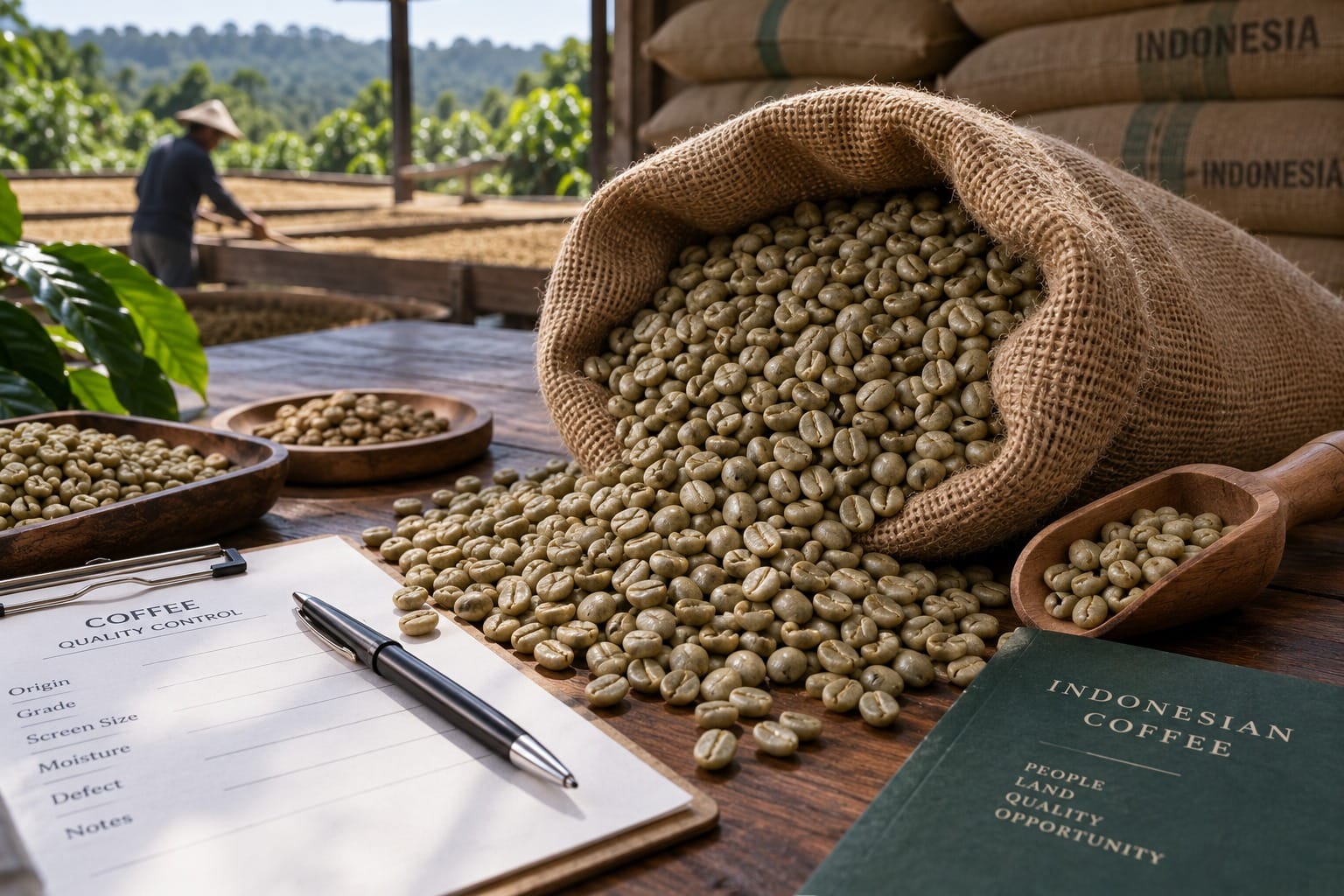
Indonesia has long been recognized as an important coffee-producing country, with Robusta accounting for the majority of its coffee production.
For international buyers, Indonesian Robusta offers opportunities across a wide range of applications—from commercial blends and espresso to soluble coffee and other industrial uses. But sourcing the right Indonesian green coffee is not simply a matter of finding the lowest price.
Buyers need to understand origin, grade, screen size, moisture, defects, processing, packaging, consistency, logistics, and export documentation before committing to a shipment.
This guide explains what international buyers should know when sourcing Indonesian Robusta green coffee beans and how to evaluate a reliable Indonesian coffee supplier.
1. Why Indonesian Robusta Coffee?
Indonesia has a diverse coffee-growing landscape extending across Sumatra, Java, Sulawesi, Bali, and other regions.
According to the USDA Foreign Agricultural Service, Indonesia’s 2025/26 coffee production was forecast to reach approximately 12.5 million 60-kg bags, with Robusta accounting for the large majority of production. USDA also reported that Indonesia’s green coffee exports were forecast at approximately 7.8 million bags for 2025/26 in its December 2025 update.
Indonesia’s Robusta sector is particularly important because of its established farming communities, regional diversity, and long history of supplying international markets.
For buyers, the attraction is not simply volume. The country offers access to different origins and supply profiles, allowing importers and roasters to select coffee according to their desired:
- Origin
- Grade
- Screen size
- Moisture level
- Defect tolerance
- Processing method
- Quantity
- Price level
- Intended application
2. Where Is Robusta Coffee Grown in Indonesia?
Indonesia’s coffee production is geographically diverse.
Southern Sumatra—including South Sumatra, Lampung, and Bengkulu—is the country’s largest Robusta-producing area. USDA estimates that Sumatra accounts for roughly 70–75% of Indonesia’s green coffee production, with Robusta concentrated in southern Sumatra.
Java also produces Robusta, including areas in Central Java and East Java.
Other coffee-producing regions include parts of:
- Sulawesi
- Bali
- Flores
- Papua
Each origin can have different agricultural conditions, varieties, farming practices, processing methods, and supply characteristics. For this reason, an international buyer should always ask:
“Where exactly does the coffee come from?”
“Indonesia” alone is not a sufficient origin description for a serious commercial coffee purchase.
3. Temanggung Robusta Coffee
One origin that deserves particular attention is Temanggung in Central Java.
Temanggung is located in a highland agricultural environment surrounded by volcanic landscapes and is known for coffee production as well as other agricultural commodities.
For buyers interested in Central Java Robusta, a supplier should be able to provide clear information about:
- Origin and farming area
- Harvest period
- Processing method
- Grade and screen size
- Moisture and defect specifications
- Packaging and available volume
At Nusantara Global Trade, our sourcing focus includes Temanggung Robusta green coffee beans from Central Java, Indonesia, with products prepared for commercial and international buyer requirements.
This origin-specific approach is important because it allows buyers to understand not only the country but also the specific supply chain behind the coffee.
4. What Is Robusta Green Coffee?
Robusta coffee is produced from Coffea canephora, a coffee species that is widely cultivated in tropical regions.
Compared with Arabica, Robusta is commonly associated with:
- Higher caffeine content
- Strong body
- Pronounced bitterness
- Lower acidity
- Earthy and woody characteristics
- Strong performance in espresso blends
- Good suitability for commercial applications
However, “Robusta” does not mean that every lot has the same quality. The final characteristics depend on:
Variety + Origin + Altitude + Farming + Harvesting + Processing + Drying + Storage + Grading
This is why professional buyers should evaluate the actual lot specification, rather than relying solely on the word “Robusta.”
5. Understanding Indonesian Robusta Grades
One of the most important things for an importer is understanding how a supplier defines its grade. Different suppliers and markets may use different commercial grading terminology.
For example, a supplier may offer:
- Grade 1: A selected higher-quality commercial Robusta green bean intended for buyers requiring tighter specifications and greater consistency.
- Grade 3 / Commercial Grade: A commercial-grade product intended for buyers prioritizing competitive pricing, volume, and specific industrial or blending applications.
However, grade names alone are not enough. Always ask for the actual specifications behind the grade.
| Specification | What the Buyer Should Check |
|---|---|
| Origin | Country, province, and specific producing region/regency |
| Species | Coffea canephora / Robusta |
| Grade | Supplier’s defined commercial grade vs. national standard (SNI) |
| Screen Size | Actual screen distribution percentages |
| Moisture | Actual measured range |
| Defects | Maximum permitted defects |
| Processing | Natural, washed, etc. |
| Crop Year | Current crop information |
| Packaging | Bag type (Jute/GrainPro) and net weight |
| Quantity | Available commercial volume (MT or containers) |
| Loading | Container configuration (e.g., bags per 20ft FCL) |
| Sample | Pre-shipment / pre-contract sample |
The key principle is simple: Buy specifications, not labels.
6. Screen Size: Why Does It Matter?
Screen size refers to the physical size of the coffee beans.
Buyers may encounter specifications such as Screen 14–18 or Screen 16–18 depending on the product. Screen size can influence:
- Sorting
- Roasting behavior
- Visual uniformity
- Blend composition
- Buyer acceptance criteria
For commercial purchasing, buyers should request the actual screen-size distribution, rather than assuming that a nominal range means every bean falls within the same size.
7. Moisture Content
Moisture is another critical specification for green coffee. Coffee that is stored or transported under inappropriate moisture conditions can experience quality deterioration.
Buyers should therefore request:
- Moisture percentage (typically defined in a range like 11.5%–12.5%)
- Measurement method
- Date of measurement
- Storage conditions
- Packaging details
The buyer should always confirm the actual value for the lot being purchased. The supplier should be able to provide a consistent specification rather than simply quoting a generic number.
8. Understanding Coffee Defects
Defect level is one of the most important factors when purchasing commercial green coffee.
Defects may include physical or quality issues such as:
- Broken beans
- Black beans
- Sour beans
- Insect-damaged beans
- Foreign material
- Unripe or abnormal beans
- Other defects defined by the applicable grading system
Different buyers may use different defect classifications and acceptance criteria. Therefore, before agreeing on a shipment, buyer and seller should establish:
Exactly how defects are defined and measured.
This prevents disputes after arrival. A professional quotation should ideally specify the maximum defect tolerance rather than simply stating “premium quality.”
9. Processing Methods
Processing can significantly affect the characteristics of green coffee. Common processing approaches include:
Natural / Dry Process
The coffee cherry is dried with the fruit surrounding the seed before further processing. Natural processing can contribute distinctive body and flavor characteristics.
Washed Process
The fruit is removed and the coffee undergoes washing before drying.
Other Processing Methods
Depending on the origin and supplier, other processing variations may be available.
For commercial buyers, processing should always be clearly stated in the product specification.
10. Harvest and Crop Year
Coffee is an agricultural commodity, so availability and quality can change from crop to crop. A buyer should ask:
- What is the crop year?
- When was the coffee harvested?
- Is the coffee from the current crop?
- How much stock is currently available?
- How has the coffee been stored?
- Is the same specification available for repeat orders?
This is especially important when buying container quantities. A supplier may have a product listed online, but that does not necessarily mean the exact specification and volume are currently available.
11. How Much Coffee Can Be Shipped in a Container?
Container loading depends on several factors:
- Container type
- Bag size
- Packaging configuration
- Maximum cargo weight
- Shipping line requirements
- Port requirements
- Buyer requirements
For example, green coffee may be packed in 60 kg bags, but the final loading quantity must be calculated according to the actual container and shipping requirements.
Before quoting, buyers should confirm: Product → Bag size → Number of bags → Net weight → Gross weight → Container → Destination port → Incoterm. This prevents misunderstandings between buyer and exporter.
12. Green Coffee Packaging
Traditional green coffee packaging often uses jute or gunny bags. For commercial export shipments, buyers should confirm:
- Bag material
- Bag weight
- Inner liner, if required
- Bag markings
- Lot identification
- Country of origin
- Product description
- Net weight
- Shipping marks
For larger or specialized orders, alternative packaging solutions may be available depending on buyer requirements.
13. How to Evaluate an Indonesian Coffee Supplier
Price is important—but it should not be the only consideration. Before selecting a supplier, ask the following questions:
- Can they clearly identify the origin? A credible supplier should be able to explain where the coffee comes from.
- Can they provide specifications? You should receive measurable specifications rather than vague descriptions.
- Can they provide samples? A sample allows the buyer to evaluate the actual product before placing a commercial order.
- Can they explain their sourcing? Ask about the relationship between the exporter, suppliers, farmers, collectors, or cooperatives.
- Can they provide consistent supply? A buyer looking for repeat shipments needs more than a single available lot.
- Can they handle export documentation? The supplier should understand the documentation and logistics required for international shipment.
- Can they communicate clearly? International coffee trade involves many details. Clear communication is essential.
14. What Should Be Included in a Coffee Quotation?
A professional Indonesian green coffee quotation should normally include:
| Field | Quotation Detail |
|---|---|
| Product | Indonesian Robusta Green Coffee Beans |
| Origin | Indonesia / specific region |
| Grade | Clearly defined commercial grade |
| Processing | Natural / Washed / other |
| Crop Year | Current crop information |
| Screen Size | Actual specification |
| Moisture | Actual specification |
| Defect | Maximum permitted level |
| Packaging | For example, 60 kg bags |
| Quantity | Metric tons / container |
| Price | USD per kg or another agreed unit |
| Incoterm | FOB / CFR / CIF / other agreed term |
| Port of Loading | For example, an Indonesian export port |
| Destination | Buyer destination port |
| Payment Terms | As mutually agreed |
| Validity | Quotation validity period |
This level of detail makes it easier for an international buyer to compare offers accurately.
15. FOB, CFR and CIF: What Buyers Should Know
International coffee quotations may use different Incoterms.
- FOB — Free On Board: The seller’s responsibility includes delivering the goods on board the vessel according to the agreed FOB point, with the specific allocation of costs and risks governed by the applicable Incoterms rules.
- CFR — Cost and Freight: The seller arranges and pays the freight to the named destination port, with risk transfer occurring according to the applicable Incoterms rule.
- CIF — Cost, Insurance and Freight: CIF adds insurance arranged by the seller to the CFR structure.
Buyers should always specify the exact Incoterm and named place/port, rather than simply saying “FOB” or “CIF.”
16. Export Documentation
Depending on the shipment and destination, international coffee transactions can involve documents such as:
- Commercial Invoice
- Packing List
- Bill of Lading
- Certificate of Origin
- Phytosanitary documentation where required
- Export/customs documentation
- Fumigation documentation where applicable
- Other destination-specific certificates or documents
Requirements can vary by destination country. Indonesia also has standards relevant to green coffee storage and transport. For example, BSN lists SNI ISO 8455:2011, “Green coffee — Guidelines for storage and transport,” as a valid standard adopted in 2025.
For this reason, buyers should confirm documentation requirements before the contract is finalized, especially when shipping to regulated markets.
17. Indonesia’s Position in the Global Coffee Market
Indonesia remains an important origin for global coffee buyers.
USDA’s December 2025 outlook placed Indonesia’s 2025/26 Robusta production at approximately 11.0 million 60-kg bags, making Indonesia one of the world’s major Robusta producers. USDA also reported that Indonesia’s major green coffee export markets include the European Union, United States, and Egypt.
Indonesia’s Ministry of Trade has also documented commercial Robusta exports to international markets. For example, in October 2025, an export shipment of 19.8 metric tons of Robusta coffee from Lampung to Egypt was formally released. These developments illustrate the established role of Indonesian coffee in international trade.
18. Why Origin and Traceability Matter
Today’s coffee buyers increasingly want to understand where their coffee comes from. A good sourcing story should answer:
- Where was the coffee grown?
- Who produces it?
- How is it processed?
- How is quality controlled?
- Where is it stored?
- How is it prepared for export?
For exporters, this is more than a marketing story. Traceable sourcing can help buyers understand the supply chain and establish confidence for repeat purchasing.
At Nusantara Global Trade, our approach is to connect international buyers with Indonesian Robusta green coffee sourced through established local supply networks, with a focus on quality, specification clarity, and reliable commercial supply.
19. Why Work With a Specialized Indonesian Robusta Supplier?
A specialized supplier can provide more than a product. The right export partner can help buyers with:
- Product Selection: Identifying a suitable grade and specification.
- Origin Selection: Selecting coffee according to the buyer’s desired origin.
- Sample Evaluation: Providing samples before commercial commitment.
- Specification Matching: Adjusting the offer according to the buyer’s requirements.
- Packaging: Preparing coffee according to agreed shipment specifications.
- Logistics: Coordinating container loading and shipment preparation.
- Export Documentation: Preparing the required export documentation according to the transaction and destination.
- Long-Term Supply: Developing a repeatable supply relationship rather than treating every transaction as a one-off purchase.
20. Buying Indonesian Robusta Green Beans: A Practical Checklist
Product & Origin
☐ Robusta / Coffea canephora
☐ Origin confirmed
☐ Grade confirmed
☐ Crop year confirmed
☐ Processing method confirmed
Quality
☐ Moisture specification
☐ Defect specification
☐ Screen size
☐ Sample evaluated
☐ Quality acceptance criteria agreed
Commercial
☐ Quantity confirmed
☐ Bag size confirmed
☐ Price confirmed
☐ Incoterm confirmed
☐ Port of loading confirmed
☐ Destination confirmed
☐ Payment terms confirmed
Export & Logistics
☐ Commercial Invoice & Packing List
☐ Certificate of Origin & Bill of Lading
☐ Phytosanitary requirements checked
☐ Loading and shipment schedule confirmed
21. Questions to Ask Before Buying
- What is the exact origin of the coffee?
- What grade and defect specification do you offer?
- What is the screen-size distribution?
- What is the moisture content?
- What processing method is used?
- What is the crop year?
- Can you provide a sample?
- What is your available quantity?
- What packaging do you use?
- Can you supply container quantities?
- What is your FOB price?
- Which Indonesian port will you load from?
- What export documents can you provide?
- What is your estimated loading schedule?
- Can you maintain the same specification for repeat orders?
22. Frequently Asked Questions
Is Indonesian Robusta good for commercial coffee production?
Yes. Indonesian Robusta is widely used in commercial coffee applications, including blends, espresso, and soluble (instant) coffee. Suitability depends on the specific lot, specification, and buyer’s intended product formulation and roast profile.
What makes Temanggung Robusta distinct from Sumatran Robusta?
While Southern Sumatra is famous for high-volume commercial Robusta with deep, heavy, and earthy profiles, Temanggung in Central Java is grown at higher highland elevations around volcanic terrain. This often produces a cleaner cup profile, high bean density, and pleasant nutty or chocolate undertones that perform exceptionally well in premium commercial espresso blends.
Ready to Source Indonesian Robusta Coffee?
Whether you require container-load pricing, technical lot specifications, or pre-shipment samples, our export team is ready to assist your procurement.