Understanding coffee screen size is essential when buying green coffee beans. Learn what screen size means, how it is measured, why it matters, and what buyers should consider when sourcing Indonesian Robusta coffee.
When purchasing green coffee beans internationally, buyers often encounter specifications such as Screen 14, Screen 15, Screen 16, Screen 17, or Screen 18. But what do these numbers actually mean?
For coffee importers, roasters, traders, and distributors, screen size is more than just a number on a specification sheet. It provides an objective measurement of bean size and uniformity, directly influencing roasting behavior, optical sorting yields, visual presentation, and commercial extraction performance.
However, screen size should never be evaluated in isolation. A coffee with a larger screen size is not automatically superior. Growing elevation, variety, post-harvest processing, moisture content, defect count, density, and cup balance all dictate commercial value. In this guide, we break down screen size from a commercial procurement perspective when sourcing Indonesian Robusta green coffee beans.
What Is Coffee Screen Size?
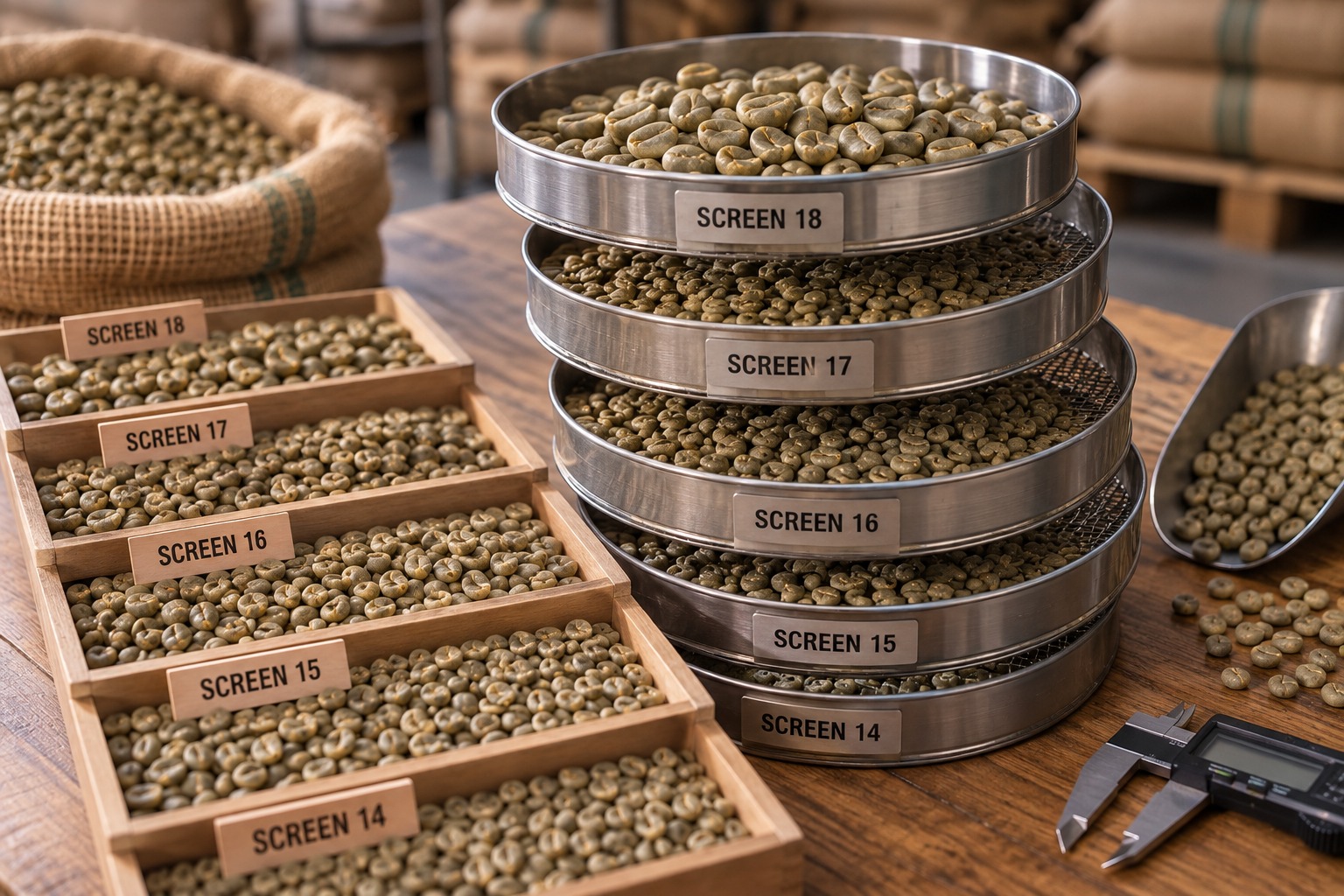
Coffee screen size refers to the physical dimension of unroasted green coffee beans, measured using perforated metal grading screens with standardized circular perforations.
In international coffee commerce, screen numbers represent the opening diameter in increments of 1/64 of an inch:
- Screen 18 = 18/64 inch (approx. 7.14 mm)
- Screen 16 = 16/64 inch (approx. 6.35 mm)
- Screen 15 = 15/64 inch (approx. 5.95 mm)
- Screen 14 = 14/64 inch (approx. 5.56 mm)
As the screen number increases, the opening size expands. Therefore: Screen 18 > Screen 16 > Screen 14 in physical bean diameter.
A green coffee lot contracted as Screen 16–18 signifies that the majority of beans fall within that calibrated range according to the agreed grading tolerance.
Coffee Screen Size Conversion Chart
The table below provides a quick conversion reference between standard imperial coffee screens and metric millimeter equivalents:
| Screen Size | Imperial Opening | Metric Opening (mm) | Commercial Classification |
|---|---|---|---|
| Screen 20 | 20/64 in | 7.94 mm | Very Large / Elephant |
| Screen 19 | 19/64 in | 7.54 mm | Extra Large |
| Screen 18 | 18/64 in | 7.14 mm | Large Bean (Standard Grade 1) |
| Screen 17 | 17/64 in | 6.75 mm | Large Bean |
| Screen 16 | 16/64 in | 6.35 mm | Medium to Large (Standard Commercial) |
| Screen 15 | 15/64 in | 5.95 mm | Medium Bean |
| Screen 14 | 14/64 in | 5.56 mm | Small Commercial Bean |
How Is Coffee Screen Size Measured?
During dry milling and export preparation, unroasted green coffee passes over a stacked deck of mechanical vibrating screens arranged in descending order:
Screen 18 Deck → Screen 17 Deck → Screen 16 Deck → Screen 15 Deck → Screen 14 Pan
Beans that fail to fall through a specific perforated deck remain on that screen level and are discharged into distinct grading chutes. For international contracts, professional procurement teams define a clear distribution (e.g., “Screen 16–18 with min. 85% retention”) rather than requesting ambiguous terms like “bold beans.”
Why Does Screen Size Matter to Roasters?
1. It Dictates Roasting Thermodynamics
Different-sized coffee beans absorb conductive and convective heat at different rates inside a roasting drum. When a batch contains extreme size variance, small beans reach first crack and caramelize prematurely while larger beans remain underdeveloped at the core. Uniform screen distribution creates a predictable heat-absorption curve and consistent batch color.
2. It Establishes Physical Uniformity in Retail Packaging
For roasters distributing whole-bean retail bags, visual appearance matters. Uniformly sized beans present a clean, high-grade visual aesthetic compared to lots containing mixed fragments and irregular pea sizes.
3. It Provides an Objective Contract Baseline
Instead of vague inquiries like “Send your best coffee,” professional buyers specify precise physical parameters: screen retention, moisture ceilings, and defect maximums. This provides a legally verifiable baseline for pre-shipment inspection (PSI) and quality arbitration.
Does a Larger Screen Size Mean Better Coffee?
The Golden Rule: Not necessarily. Screen size describes geometry, not flavor quality.
A Screen 18 bean is not inherently superior in cup cleanliness or sweetness compared to a Screen 15 bean. Screen size indicates physical dimensions, whereas cup quality is governed by elevation, cherry maturity at harvest, fermentation hygiene, and drying speed. A high-grown, densely structured Screen 15 bean will consistently outperform a hollow, defect-heavy Screen 18 bean.
Screen Size vs. Coffee Grade
Importers frequently confuse screen sizing with commercial grade tiers. They are separate parameters:
- Screen Size: Defines the physical diameter and sizing distribution of the beans.
- Coffee Grade: An aggregate quality designation incorporating defect point counts, foreign matter thresholds, color, moisture, and screen uniformity.
Why Screen Distribution Percentages Matter
Consider two supplier offers:
- Supplier A: Quoting Screen 16–18 with 90% retention across Screens 16, 17, and 18.
- Supplier B: Quoting Screen 14–18 with only 50% retention above Screen 16.
Supplier A offers a tightly calibrated lot that will roast evenly with minimal drum adjustments. Supplier B offers a wide commercial spread that may require slower roaster charge temperatures to prevent scorching the smaller beans. Always request the certified percentage distribution on quotation sheets.
Understanding Indonesian Robusta Green Beans
In Indonesia, Robusta cultivation across Central Java and Southern Sumatra produces distinct screen profiles. In our commercial supply chain out of Temanggung, Central Java, coffees are prepared according to strict physical specifications:
- Temanggung Robusta Green Bean Grade 1: Focused on large Screen 16–18 beans, max 11 defect points, and Natural Dry processing for premium espresso formulations.
- Temanggung Robusta Green Bean Grade 3 (Asalan): Standard commercial distribution across Screen 14–18, offering high cost-efficiency for volume roasting and soluble extraction.
Screen Size and Quality Control Verification
Export grading involves a structured physical QA protocol:
- Representative Sampling: Drawing composite samples across multiple bags throughout the warehouse lot.
- Laboratory Sieve Shaking: Passing a 300g sample through a calibrated screen tower for a timed mechanical shake cycle.
- Screen Distribution Logging: Weighing the beans retained on each deck to calculate precise percentage distributions.
- Moisture Testing: Measuring internal moisture using calibrated capacitance moisture meters (targeting 11.5%–12.5%).
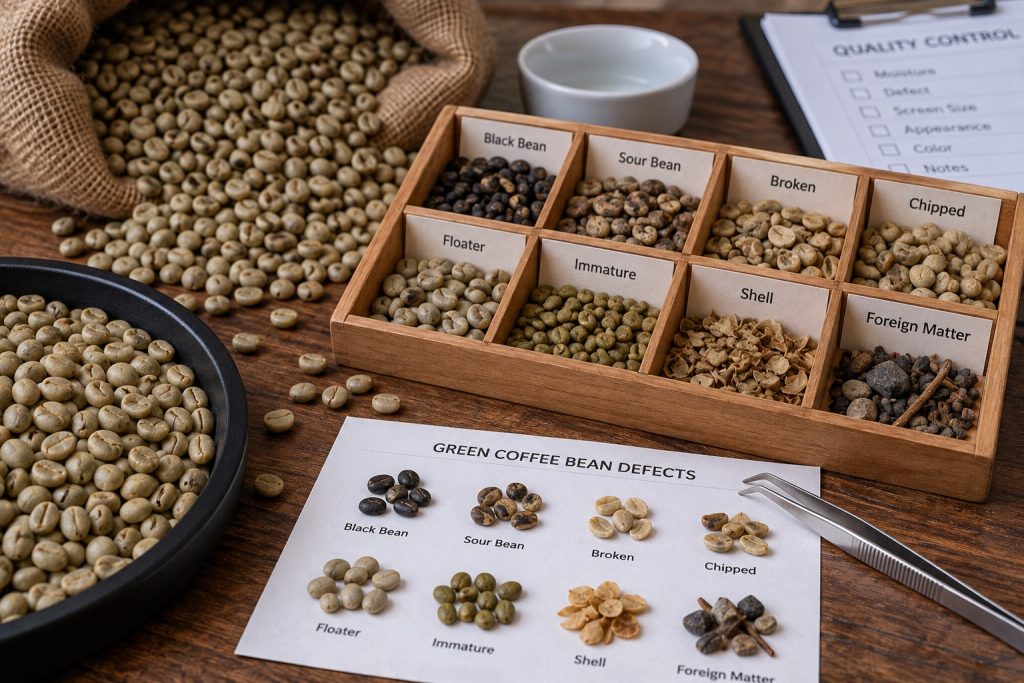
- Defect Tally: Hand-sorting to verify defect thresholds match contract standards.
What Should Buyers Ask a Green Coffee Supplier?
When sending an RFQ to an Indonesian exporter, request a complete physical specification sheet covering:
- Precise screen size and percentage distribution above the target sieve
- Measured moisture percentage at origin warehouse
- Maximum certified defect point count per 300g sample
- Post-harvest processing method (Natural Dry / Washed)
- Crop year and packaging format (60 kg jute bags)
- Pre-shipment sample (PSS) availability via courier
Common Mistakes Buyers Make
- Equating Large Beans with Premium Flavor: Assuming Screen 18 automatically tastes better than Screen 16.
- Neglecting Screen Distribution: Specifying Screen 18 without setting an agreed tolerance for beans falling into Screen 16 or 15.
- Skipping Pre-Shipment Samples: Relying on digital specification sheets without test-roasting a physical lot sample.
- Comparing Price Without Comparing Specs: A cheaper quotation often conceals a wider screen spread (Screen 12–16) and higher defect levels.
To master the complete procurement process, read our comprehensive guide on how to import green coffee beans from Indonesia.
A Practical Green Coffee Buying Checklist
Physical Specifications
☐ Target screen size confirmed (e.g., 16–18)
☐ Screen retention percentage agreed (e.g., ≥85%)
☐ Maximum moisture ≤ 12.5% verified
☐ Maximum defect point threshold confirmed
☐ Processing method defined (Natural/Washed)
Commercial & Logistics
☐ Pre-shipment sample tested & approved
☐ Total volume in MT / 20ft FCL agreed
☐ 60 kg export jute packaging verified
☐ Incoterm (FOB/CFR/CIF) designated
☐ Export documentation (PEB, ICO) listed
Frequently Asked Questions
What does Screen 18 mean in coffee?
Screen 18 indicates green coffee beans retained on a sieve with perforations of 18/64 of an inch (approx. 7.14 mm in diameter). It represents a large bean classification in commercial coffee trading.
Is Screen 18 better than Screen 16?
Not necessarily. Screen size denotes physical bean dimensions, not cup quality. High-density Screen 16 beans frequently deliver superior flavor balance and crema density compared to lower-density Screen 18 beans.
What is Screen 16 coffee?
Screen 16 refers to beans retained on a 16/64-inch sieve (approx. 6.35 mm). It is the benchmark standard for commercial specialty and premium commercial blending across international markets.
What does Screen 16–18 mean?
A Screen 16–18 specification means the lot has been screened to retain large beans falling within the 16/64 to 18/64-inch range, providing optimal roasting uniformity for commercial drum roasters.
Does bean size affect roasting profiles?
Yes. Uniform bean sizing ensures even convective heat transfer throughout the roasting drum, preventing smaller beans from scorching while larger beans finish developing.
Sourcing Indonesian Robusta Green Beans
For international buyers, mastering screen size is an essential step toward securing predictable, repeatable coffee shipments. At Nusantara Global Trade, we connect international roasters, importers, and distributors with export-ready Indonesian Robusta green coffee beans sourced directly from Central Java.
Whether you require Screen 16–18 Grade 1 for espresso blending or Screen 14–18 Grade 3 for commercial manufacturing, our team provides lot specifications, samples, and container-scale fulfillment.
Looking for Indonesian Robusta Green Beans?
Contact our export desk today with your target grade, required screen distribution, and destination port to receive current FOB/CIF pricing and physical samples.