Green coffee bean quality is one of the most critical factors to evaluate before committing capital to commercial coffee shipments.
For importers, roasters, distributors, and coffee traders, understanding defects helps determine whether a coffee lot matches your technical specifications, whether the price is commercially viable, and how the beans will perform in your roaster drum.
A professional green coffee evaluation does not rely on visual appearance alone. Physical defects, moisture content, bean size distribution, processing method, origin terroir, and sensory attributes all contribute to the aggregate quality assessment of a lot. For buyers sourcing Indonesian Robusta green coffee beans, understanding defects is particularly essential when comparing commercial tiers and negotiating contract terms.
What Are Green Coffee Bean Defects?
A green coffee defect is an abnormal physical characteristic of a coffee bean—or foreign material present in a coffee sample—that is considered undesirable according to international grading standards or commercial contract specifications.
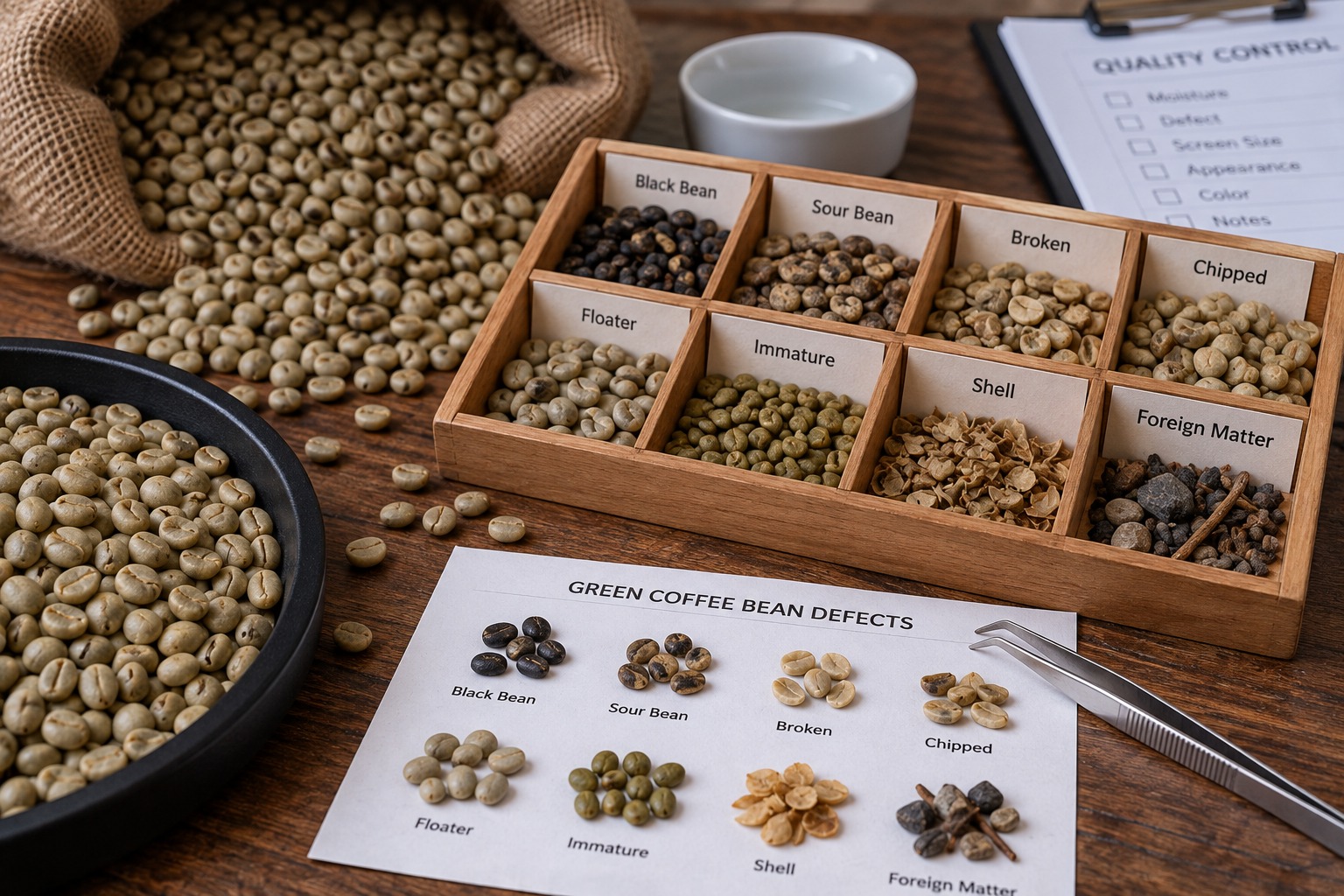
Physical defects represent unwanted structural, biological, or chemical deviations, including discolored seeds, fragmented beans, dried cherry husks, parchment skins, and non-coffee contaminants. In international trade, defects are universally divided into primary defects (which severely compromise cup cleanliness and food safety) and secondary defects (which primarily affect sorting loss and roasting uniformity).
Defects can emerge at every milestone across the agricultural and post-harvest journey:
Cultivation → Harvesting → Processing → Drying → Storage → Dry Milling → Sorting → Ocean Transit
Why Do Green Coffee Defects Matter?
1. They Directly Impact Cup Quality and Flavor
Certain defects introduce severe sensory taints into roasted coffee. Depending on the severity and defect type, tainted beans produce chemical, moldy, earthy, phenolic, sour, vinegar-like, or harshly astringent notes. Because green coffee contains the precursor compounds that develop during caramelization and Maillard reactions, unculled defects will ruin an entire batch profile.
2. They Dictate Commercial Value and Roaster Yield Loss
Lots with tightly controlled defect ceilings command premium commercial positioning. Conversely, higher-defect lots result in substantial mass loss during optical sortexing and mechanical destoning at your roastery. Assessing the true cost per kilogram requires calculating sorting yield loss alongside the FOB purchase price.
3. They Determine Batch Consistency
For commercial roasters running recurring supermarket lines or espresso blends, shipment-to-shipment consistency is vital. Contracts must define measurable boundaries:
- Maximum certified defect ceiling per sample size
- Moisture equilibrium window (11.5%–12.5%)
- Screen size retention thresholds
- Sample extraction and quality arbitration rules
Primary vs. Secondary Defects
Primary Defects (Severe Impact)
Primary defects represent critical quality and safety deviations. Even a minimal presence can disqualify a lot from Grade 1 status or taint an entire commercial roast:
- Full Black Beans: Dead, oxidized beans caused by severe nutritional deficiency, over-fermentation, or fungal infection; produces bitter, ash-like, and medicinal taints.
- Full Sour / Severely Discolored Beans: Beans that underwent uncontrolled microbial fermentation inside overripe cherries or contaminated washing channels; produces pungent vinegar and rotting fruit flavors.
- Severe Insect Damage: Beans perforated with multiple boreholes caused by the coffee berry borer (Hypothenemus hampei); compromises bean structural density and harbors mold spores.
- Dried Coffee Pods / Cherries: Unhulled dried fruit that failed to separate during dry milling; burns easily in the roaster drum.
- Foreign Matter: Stones, sticks, nails, wire, plastic, or dirt clumps; poses severe food safety hazards and destroys commercial grinding burrs.
Secondary Defects (Moderate Impact)
Secondary defects generally have a lower individual sensory impact, though cumulative quantities degrade visual appearance and roasting precision:
- Partial Black / Partial Sour Beans: Seeds exhibiting localized oxidation or mild fermentation taints.
- Broken, Chipped, or Cut Beans: Beans mechanically damaged by miscalibrated hullers or destoners; small fragments scorch prematurely during roasting.
- Immature / Unripe Beans: Seeds picked before physiological maturity, often displaying tightly clinging silver skins; produces grassy, papery, and astringent notes.
- Floater / Low-Density Beans: Spongy, chalky beans that failed to develop proper structural density; roasts unpredictably and tastes flat.
- Parchment Skins & Husks: Residual protective layers that increase chaff volume during roasting.
Defect Count vs. Defect Severity
The Commercial Rule: “Fewer defects does not automatically mean a lot is suitable for your business.”
Defect numbers must be interpreted through the lens of sample size, counting rules, and commercial intent:
- Sample Mass: In international trade, defect counts are benchmarked against a standardized sample weight (typically 300 grams under ICO and Indonesian SNI standards).
- Point Systems vs. Absolute Count: Some standards assign fractional points (e.g., 5 broken beans = 1 full defect point), while others count every defective seed individually.
- Application Fit: A Grade 3 lot with 35 secondary defect points may be commercially ideal for a dark-roasted industrial soluble coffee, whereas an espresso roaster requires a Grade 1 lot capped at 11 points.
How Are Green Coffee Beans Evaluated?
A rigorous quality control protocol follows five structured steps:
- Representative Composite Sampling: Drawing samples evenly across bags throughout the warehouse lot using a hollow trier probe.
- Visual Table Inspection: Spreading a 300g sample across a flat, neutral-colored inspection tray under 1,000+ lux daylight illumination.
- Defect Separation & Tally: Hand-sorting beans into primary and secondary categories, recording the defect point total.
- Moisture & Water Activity Testing: Measuring internal moisture using a calibrated benchtop capacitance meter (confirming 11.5%–12.5%).
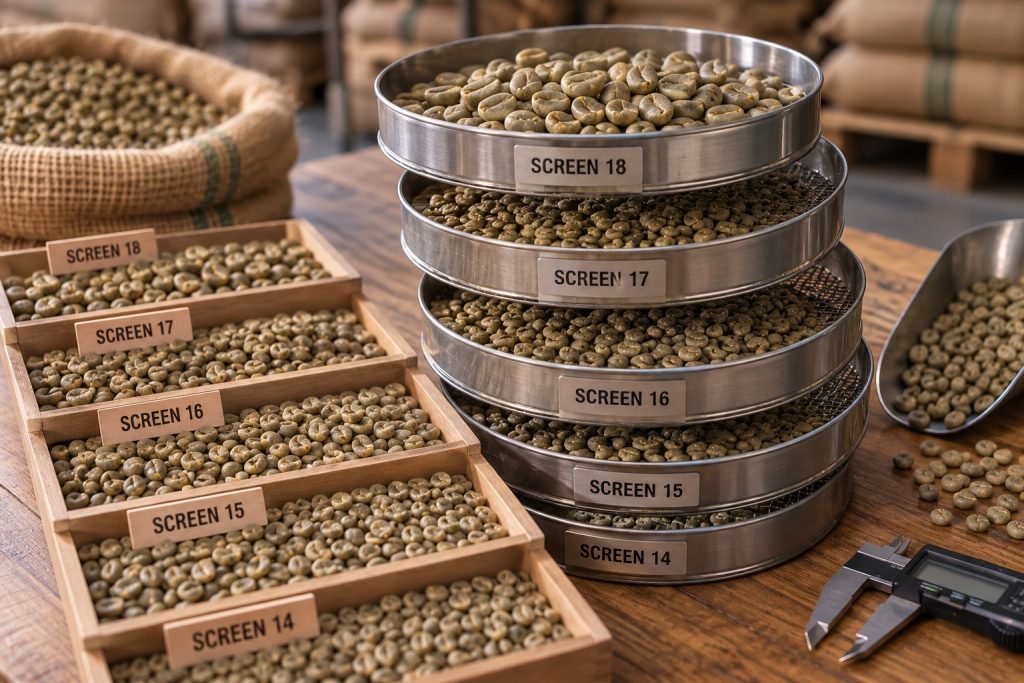
- Screen Size Verification: Running the sample through calibrated grading sieves to verify physical bean size distribution.
Defects Are Only One Part of Green Coffee Quality
A complete commercial specification provides a multidimensional profile rather than an isolated defect number. Below is an example of an export-ready specification sheet:
| Specification Parameter | Standard Commercial Specification |
|---|---|
| Origin | Temanggung, Central Java, Indonesia |
| Species | Coffea canephora (Robusta) |
| Commercial Grade | Grade 1 (Selected Quality) |
| Processing | Natural Dry Processed |
| Screen Size | Screen 16–18 (min. 85% retention) |
| Moisture Content | 11.5% – 12.5% max |
| Defect Allowance | Max. 11 points (per 300g sample) |
| Packaging | 60 kg clean export jute bags |
| Crop Year | Current Harvest (2026) |
Understanding Indonesian Robusta Grading Tiers
The term “Grade 1” is not universal—it must be backed by verified counting parameters. At Nusantara Global Trade, we offer two distinct, clearly defined commercial tiers out of Central Java:
- Temanggung Robusta Green Bean Grade 1: Large Screen 16–18 beans, strictly controlled to a maximum defect count of 11 points. Engineered for premium espresso roasting requiring thick crema and low sortex loss.
- Temanggung Robusta Green Bean Grade 3 (Asalan): Commercial-grade Screen 14–18 beans with an allowable defect threshold of Max. 44 points. Designed for high-volume commercial blends, supermarket lines, and soluble extraction.
What Should International Buyers Ask an Indonesian Supplier?
Before issuing an international purchase order, require your supplier to confirm:
- What specific defect counting methodology and sample weight (e.g., 300g) are utilized?
- What is the certified breakdown between primary and secondary defects?
- What is the measured moisture percentage prior to container stuffing?
- Can you provide a pre-shipment sample (PSS) drawn directly from the export warehouse?
- Do you provide electronic PEB customs clearance, Form ICO origin certificates, and phytosanitary documentation via your export operations desk?
Why Pre-Shipment Sampling Matters
Digital specification sheets cannot replace physical verification. Requesting a representative Pre-Shipment Sample (PSS) allows your quality control lab to conduct:
- Physical verification: Performing your own screen sizing and 300g defect count.
- Test roasting: Evaluating how the lot behaves under heat—observing drum smoke, expansion uniformity, and first crack timing.
- Cupping analysis: Confirming the absence of moldy, musty, or phenolic taints in the roasted cup.
Green Coffee Defects and Indonesian Robusta
Indonesia is one of the world’s most significant Robusta producers. In the volcanic highlands of Temanggung, Central Java, disciplined smallholder harvesting and structured post-harvest drying allow local mills to produce remarkably dense, clean green beans.
At Nusantara Global Trade, our approach is built on end-to-end quality governance:
Origin Sourcing → Selective Aggregation → Precision Milling → Optical Sortexing → Quality Control → Export Bagging
Our dedicated sourcing and quality control protocols ensure export lots correspond exactly to the defect thresholds agreed upon in your purchase contract.
Frequently Asked Questions
What is considered a green coffee bean defect?
A defect is any physical, biological, or chemical irregularity in a green bean—or non-coffee contaminant in a sample—that deviates from contract specifications, including black beans, insect damage, broken fragments, and foreign stones.
What is the difference between primary and secondary defects?
Primary defects (such as full black beans, full sour beans, and foreign stones) introduce severe sensory taints or machinery hazards. Secondary defects (such as partial chips, broken fragments, and immature beans) primarily affect visual uniformity and sorting yield loss.
Does a lower defect count guarantee better cup flavor?
Not necessarily. Defect count reflects physical cleanliness and sorting discipline. Total quality also depends on harvest elevation, cherry ripeness, drying hygiene, bean density, and moisture balance.
What is the defect threshold for Indonesian Robusta Grade 1?
Under standard Indonesian export specifications (SNI) and Nusantara Global Trade criteria, Grade 1 Robusta allows a maximum defect point ceiling of 11 points per 300g sample.
Can buyers specify custom defect tolerances?
Yes. Commercial buyers can negotiate custom defect limits, specific screen size percentages, and specialized packaging (such as GrainPro liners) to match their proprietary manufacturing requirements.
Source Specification-Verified Indonesian Robusta
Understanding green coffee defects empowers buyers to make profitable, risk-managed procurement decisions. At Nusantara Global Trade, we connect international roasters, importers, and coffee trading companies with verified Indonesian Robusta green coffee beans sourced directly from Central Java.
Whether you require Grade 1 espresso components or high-volume commercial Grade 3 supplies, our export desk is ready to assist your procurement.
Request a Coffee Export Quotation
Contact our export desk today with your target grade, required defect tolerance, and destination port to receive lot specifications, pre-shipment samples, and current FOB/CIF pricing.