
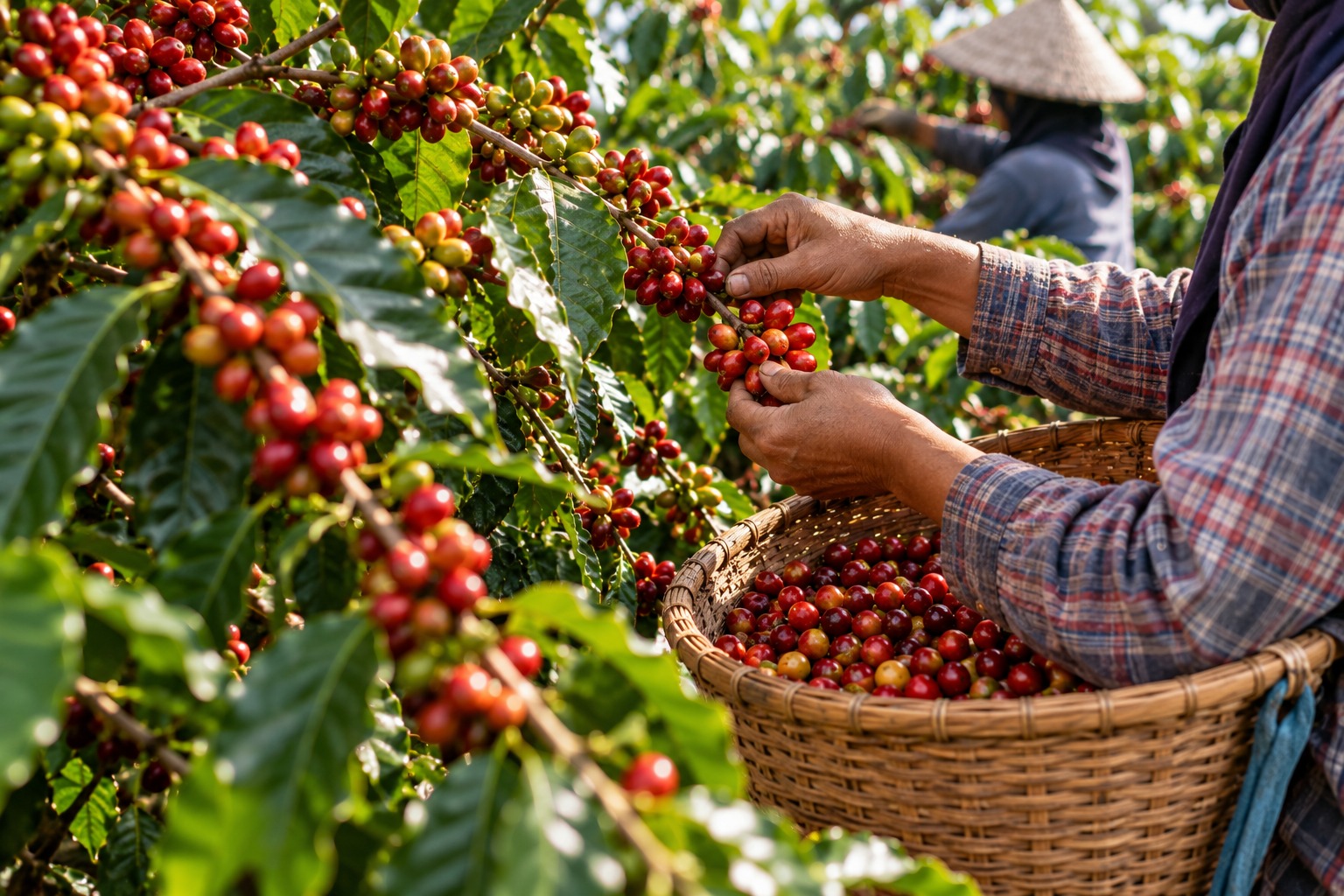
Understanding Indonesia’s coffee harvest calendar is essential for importers, roasters, traders, and green coffee buyers planning their next purchase. Learn when Indonesian Robusta and Arabica are harvested, how harvest timing affects availability and quality, and what international buyers should consider when sourcing Indonesian green coffee beans.
Indonesian Coffee Harvest Season at a Glance
Indonesia’s coffee harvest does not occur simultaneously across the archipelago. The timing varies substantially according to:
- Botanical species (Coffea canephora vs. Coffea arabica)
- Growing region and volcanic topography
- Altitude and elevation bands
- Equatorial monsoon rainfall patterns
- Flowering cycles and cherry maturation speed
- Local smallholder farming and drying practices
For international buyers, this regional variance is critical because harvest timing directly impacts fresh-crop availability, processing schedules, green bean density, physical quality selection, warehouse logistics, and shipping container bookings.
For the majority of Indonesian Robusta green coffee beans, the main harvest occurs during the middle of the calendar year. In Southern Sumatra (Lampung, South Sumatra, Bengkulu), picking typically runs from May to August, while Robusta regions across Central and East Java harvest from June to September.
In the highland volcanic terroir of Temanggung, Central Java, the Robusta harvest centers around the mid-year window, with July and August representing the peak harvesting period.
1. When Is Indonesian Coffee Harvested?
Because Indonesia straddles the equator with distinct regional microclimates, coffee flowering and cherry maturation occur in regional waves throughout the year.
| Region / Coffee Classification | Typical Harvest Window | Peak Harvesting Period |
|---|---|---|
| Southern Sumatra Robusta (Lampung/Bengkulu) | May – August | June – July |
| Central Java Robusta (Temanggung/Semarang) | June – September | July – August |
| East Java Robusta (Malang/Ijen) | June – September | July – August |
| Northern Sumatra Arabica (Gayo/Aceh) | March–May & Oct–Dec | November – December |
| South Sulawesi Arabica (Toraja) | May – August | June – July |
*These timelines represent historical operational baselines. Seasonal weather variability, unseasonal rainfall during flowering, and microclimates can advance or delay cherry maturation by several weeks.
2. Understanding the Indonesian Robusta Harvest Season
Robusta represents the commercial foundation of Indonesia’s coffee industry, consistently accounting for more than 85% of total national coffee production. Sourcing centers heavily on the southern belt of Sumatra and the volcanic highlands of Central Java.
Understanding harvest progression allows commercial buyers to coordinate procurement timelines effectively:
Cherry Harvest → Wet/Dry Processing → Sun Drying → Dry Milling → Optical/Mechanical Sorting → Warehouse QC → Container Loading → Ocean Export
The transition time between fresh-picked cherry and export-ready green bean typically requires 3 to 6 weeks, depending on weather conditions during drying and milling queue times.
3. Temanggung Robusta Coffee Harvest Season
For procurement teams seeking high-density, low-defect Central Java Robusta, Temanggung Robusta coffee offers exceptional commercial consistency. Cultivated across more than 12,000 hectares on the fertile volcanic plateaus of Mount Sindoro and Mount Sumbing, Temanggung produces large-screen commercial beans renowned for heavy body and dark chocolate notes.
The Temanggung Robusta harvest follows a distinct seasonal timeline:
- Early Harvest (May – June): Initial selective picking begins in lower-elevation districts (such as Pringsurat). Cherry volumes ramp up gradually.
- Peak Harvest (July – August): Maximum daily cherry arrivals at local processing mills across highland districts (Candiroto, Gemawang, Bejen, Wonoboyo). The ideal period for pulling representative pre-shipment samples (PSS) and locking in container contracts.
- Late Harvest & Tail (September – October): Final strip-picking and completion of patio drying. Dry mills transition to sorting, grading, and export packaging.
4. What Happens During the Coffee Harvest?
Step 1 — Selective Harvesting
Quality begins on the tree. Generational smallholder farmers hand-harvest ripe red cherries. Selective harvesting prevents unripe green fruit from entering processing lots, which is critical for avoiding grassy, astringent taints in the roasted cup.
Step 2 — Collection & Aggregation
Freshly harvested cherries are transported daily from hillside smallholdings to centralized village collection points, cooperatives, and local processing stations.
Step 3 — Post-Harvest Processing
For Indonesian Robusta, the predominant method is Natural / Dry Processing, where whole cherries are sun-dried intact on clean concrete patios or raised bamboo beds. A smaller volume undergoes Washed processing, where fruit pulp is mechanically removed prior to washing and drying.
5. Drying: The Decisive Quality Phase
After processing, coffee must be dried down to a stable moisture equilibrium. Drying is the most weather-sensitive stage of the harvest season:
- Target Moisture Window: 11.5% to 12.5% max
- Sun Drying Duration: 10 to 18 days for Natural Robusta
- Active Management: Frequent raking and turning to prevent localized fermentation pockets and ensure uniform bean density
Improper drying or excessive moisture results in mustiness, premature bean fading, and mold development during maritime container transit.
6. From Harvest to Export Green Bean
Once dried to the legal export moisture threshold, coffee is moved to dry mills for hulling (removing the dried cherry husk), mechanical grading through vibrating sieves, gravity separation, and optical sortexing to eliminate physical defects.
Only after physical quality control inspection is the coffee bagged into standard 60 kg export jute sacks for warehouse storage and container stuffing.
7. Why Harvest Timing Matters to International Buyers
- New-Crop Freshness: Fresh-crop green coffee exhibits optimal enzymatic vitality, vibrant color, and maximum cup aromatics, ensuring prolonged warehouse shelf-life at your destination roastery.
- Sample Evaluation Window: Requesting samples during peak harvest (July–August for Java) provides an accurate baseline of the current crop’s true physical and sensory characteristics.
- Supply Security: Top-tier Grade 1 lots with low defect counts and Screen 16–18 sizing sell out quickly. Early contracting locks in required volumes before stocks are depleted.
- Logistics Planning: Timely bookings avoid ocean carrier peak-season freight surcharges and congested shipping windows out of primary Indonesian ports.
8. Does Harvest Season Guarantee Lower Prices?
Procurement Reality: Peak harvest season does not automatically mean cheap coffee.
While local supply volumes peak during harvest, commercial export pricing is governed by macro factors: global coffee futures markets (London Robusta), regional crop yields, internal domestic demand, currency exchange rates, and international roasting demand. Harvest season should be leveraged as an availability and quality window, rather than an automatic discounting period.
9. Weather Volatility and Harvest Adjustments
Agricultural commodities remain vulnerable to climatic disruptions. Excessive or unseasonal rainfall during the delicate flowering phase can cause blossom drop, leading to localized yield reductions.
For international buyers, this underscores a fundamental sourcing truth: a harvest calendar is a strategic planning guide, not a volume guarantee. Regular communication with an established on-the-ground supplier provides real-time visibility into actual mill arrivals and lot availability.
10. What Should Buyers Ask an Indonesian Coffee Supplier?
Before issuing an international purchase order, confirm these technical parameters:
- What specific harvest month and crop year does this physical lot originate from?
- What commercial grade and certified maximum defect count are guaranteed?
- What is the measured screen distribution (e.g., Screen 16–18 vs. Screen 14–18)?
- What is the verified moisture content prior to bagging (target: 11.5%–12.5%)?
- Which Indonesian export port will be utilized (e.g., Tanjung Mas, Semarang)?
- Can you supply a pre-shipment sample (PSS) drawn directly from current harvest mill runs?
11. When Should You Contact an Indonesian Supplier?
For commercial roasters and green coffee importers planning new-crop purchases, procurement discussions should commence 1 to 2 months prior to peak harvest:
- April – May: Initial procurement discussions, specification mapping, and annual volume forecasting.
- June – July: Pre-crop verification, initial sample approvals, and contract finalization.
- August – October: Peak container stuffing, Indonesian export customs (PEB) clearance, and ocean departures.
12. Indonesian Robusta for International Buyers
Indonesia remains one of the world’s most critical Robusta origins. With national green coffee exports frequently surpassing 7.5 to 8.0 million bags annually, Indonesian Robusta provides global blenders with unmatched crema volume, deep chocolate-hazelnut profiles, and outstanding extraction efficiency.
Learn more about shipping configurations and export customs in our guide on how to import green coffee beans from Indonesia.
13. Sourcing Temanggung Robusta Green Beans
At Nusantara Global Trade, we connect international roasters, importers, and coffee trading companies with verified Indonesian Robusta green coffee beans sourced directly from Central Java.
Our commercial portfolio out of Temanggung includes:
- Temanggung Robusta Green Bean Grade 1: Large Screen 16–18 beans, max 11 defect points, and Natural Dry processing for premium commercial espresso blends.
- Temanggung Robusta Green Bean Grade 3 (Asalan): High-volume commercial grade offering Screen 14–18 sizing and economical pricing for commercial roasting and soluble extraction.
14. Planning Your Next Indonesian Coffee Purchase
Navigating the Indonesian coffee harvest calendar successfully requires combining seasonal awareness with disciplined supply chain partnerships:
Harvest Calendar → Supplier Alignment → Sample Approval → Specification Locking → FCL Shipment
Our dedicated export operations team coordinates inland logistics, fumigation, phytosanitary clearance, and ocean container bookings to ensure fresh-crop lots arrive at your roastery in pristine commercial condition.
Frequently Asked Questions
When is Indonesian Robusta coffee harvested?
Robusta harvesting varies by island. In Southern Sumatra, harvesting spans May to August. In Central and East Java (including Temanggung), the main harvest runs from June to September, with peak cherry volume arriving during July and August.
When does the Temanggung Robusta harvest peak?
The peak harvesting and processing period in Temanggung, Central Java, takes place during July and August.
When is the ideal time to buy fresh-crop Indonesian green coffee?
Buyers planning for fresh-crop Robusta should initiate contract and specification discussions between May and July to secure pre-shipment samples and lock in container capacity during peak milling in August and September.
Does harvest season guarantee lower spot prices?
No. Coffee prices are driven by international terminal markets, domestic processing demand, and crop yields. Harvest season guarantees peak freshness and volume availability, but not necessarily discounted rates.
Can international buyers order container-load volumes?
Yes. Commercial shipments are routinely supplied in 20ft full container loads (carrying roughly 300 to 320 bags / 18.0 to 19.2 Metric Tons net weight), packaged in 60 kg export jute sacks.
Ready to Source Indonesian Green Coffee Beans?
Nusantara Global Trade supplies verified Indonesian Robusta green coffee beans from Central Java for importers, roasters, and distributors worldwide. Contact our export desk today to discuss upcoming crop availability, request pre-shipment samples, or secure a formal container quotation.
Request an Indonesian Green Coffee Quotation
Tell us your target grade, required volume, destination port, and preferred Incoterm (FOB/CFR/CIF). Our team will provide current crop availability, lot specs, and competitive pricing.