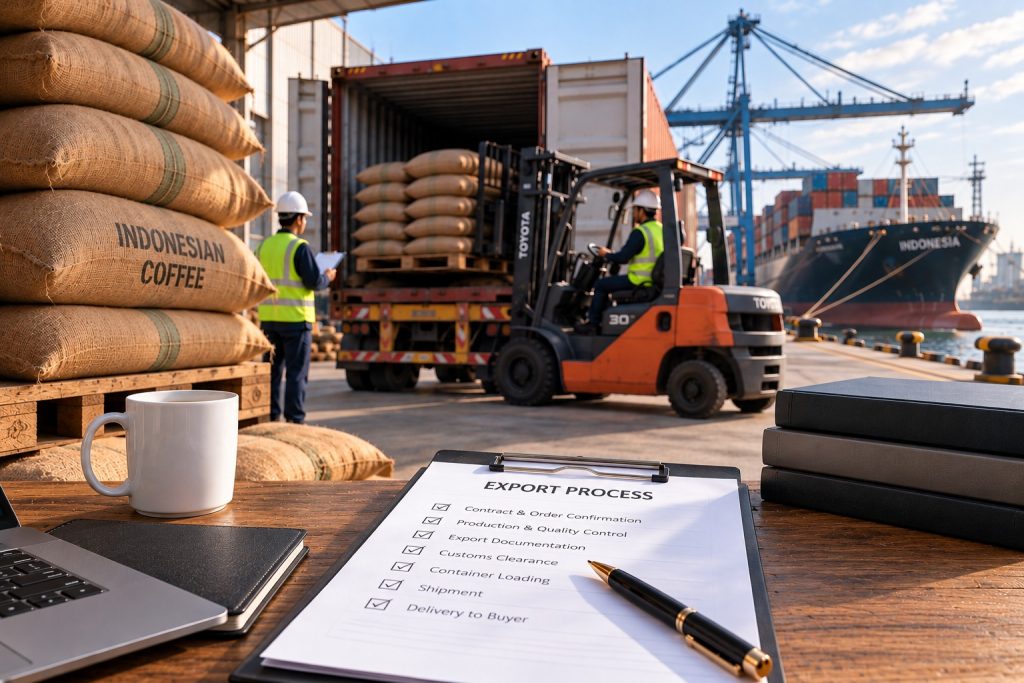
Indonesia has long been recognized as an important coffee-producing origin, offering a diverse range of Arabica and Robusta coffees from regions across the equatorial archipelago.
For international coffee roasters, importers, distributors, and trading companies, sourcing directly from Indonesia provides access to diverse microclimates, grades, processing methods, and commercial specifications. But importing green coffee involves far more than simply finding an exporter and booking cargo space.
A successful commercial transaction requires meticulous attention to origin verification, quality specifications, pre-shipment sampling, Incoterms, Indonesian export customs (PEB), phytosanitary clearance, container logistics, and destination compliance.
In this guide, we break down the entire import process step by step—from vetting an Indonesian coffee exporter to clearing your container at your destination port.
1. Why Import Green Coffee from Indonesia?
Indonesia offers green coffee spanning distinct island terroirs, altitude bands, and post-harvest styles across Sumatra, Java, Bali, Flores, and Sulawesi.
For commercial and specialty buyers alike, the primary advantage is specification flexibility. Depending on the origin and exporter, buyers can source:
- Washed, Natural, and Semi-Washed (Wet Hulled) preparations
- Strictly sorted large bean screens (Screen 16–18, Screen 18–19)
- Tightly controlled moisture levels (11.5%–12.5%)
- Certified defect tiers (from Grade 1 selected to commercial blending grades)
- Full container loads (FCL) or specialized LCL consignments
For roasters seeking heavy-bodied, high-crema components, Indonesian Robusta coffee from regions such as Central Java (Temanggung) and Southern Sumatra represents one of the world’s most versatile commercial foundations.
2. What Types of Green Coffee Are Available?
Before issuing requests for quotation (RFQs), define which species fits your formulation:
Arabica (Coffea arabica)
Cultivated at elevations typically above 1,000 meters (Sumatra Aceh/Gayo, North Toraja, West Java, Kintamani Bali). Known for complex aromatics, bright acidity, and delicate fruit or herbal notes.
Robusta (Coffea canephora)
Cultivated across highland plateaus and lowland volcanic slopes. Characterized by dense body, high soluble solids, low acidity, deep cacao notes, and thick crema stability. Ideal for commercial roasters, espresso blends, and soluble extraction.
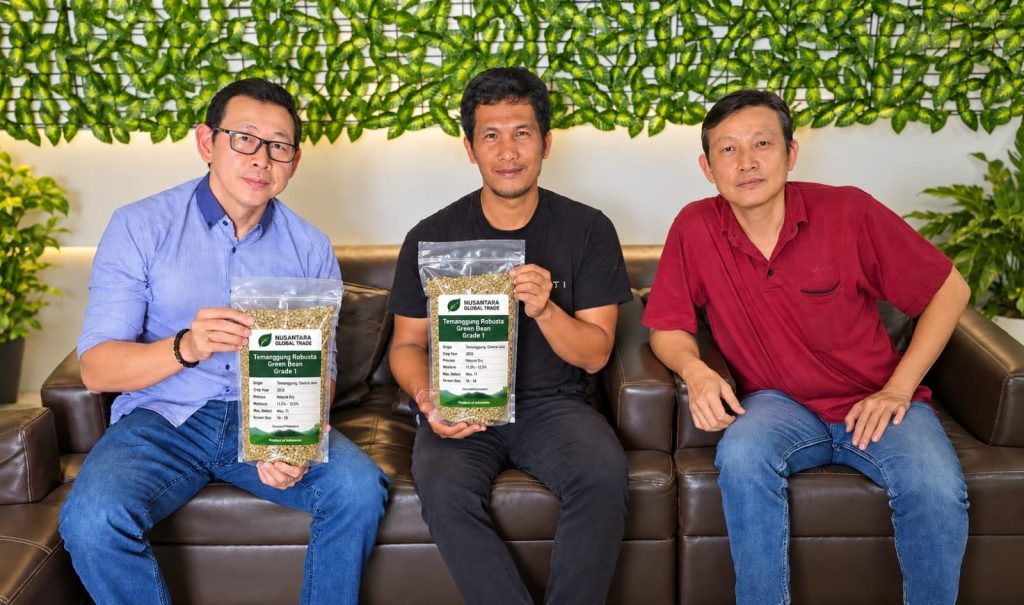
At Nusantara Global Trade, our focus centers on high-grade Indonesian Robusta green coffee beans, with specialized sourcing out of the premier volcanic highland origin of Temanggung, Central Java.
3. Step 1: Define Your Coffee Requirements
One of the most frequent mistakes international buyers make is sending a vague message asking: “What is the price of Indonesian green coffee?”
Green coffee pricing varies drastically based on crop year, defect thresholds, screen sizes, and export terms. Before requesting a quote, define your sourcing brief:
- Product & Species: Arabica or Robusta unroasted green coffee beans
- Origin: Country (Indonesia) and specific region/regency (e.g., Temanggung, Central Java)
- Grade: Grade 1 (low defect), Grade 3 (commercial), or custom specification
- Physical Parameters: Target screen size (e.g., Screen 16–18), maximum moisture (e.g., ≤ 12.5%), defect limit
- Processing Method: Natural Dry, Fully Washed, or Semi-Washed
- Target Volume: Total metric tons (MT) or number of 20ft full container loads (FCL)
- Packaging: 60 kg clean export jute bags (with or without GrainPro hermetic liners)
- Destination: Specific destination port (e.g., Port of Hamburg, Rotterdam, or Long Beach) rather than just the country name
4. Step 2: Find a Reliable Indonesian Coffee Supplier
Selecting the right export partner protects your capital and prevents costly destination customs rejections. Screen prospective suppliers against four criteria:
- Corporate Legitimacy: Registered Indonesian export company (NIB/TDP), legitimate business address, active trade presence, and accessible direct communication via WhatsApp and corporate email.
- Product & Supply Chain Transparency: Clear insight into regional mills, collector networks, and current crop readiness.
- Physical Verification: Ability to provide real-time warehouse lot photos, moisture meter readings, and laboratory analysis reports.
- Export Operational Capability: Proven experience with Indonesian Customs procedures, shipping line bookings, container stuffing, and international document compliance.
5. Step 3: Request Product Specifications
A professional coffee offer should always provide a verifiable technical sheet rather than arbitrary marketing adjectives like “super” or “premium.”
A standard export specification benchmark (such as our Grade 1 offering) should clearly outline:
- Product: Indonesian Robusta Green Coffee Beans
- Origin: Temanggung, Central Java, Indonesia
- Species: Coffea canephora
- Commercial Grade: Grade 1
- Processing: Natural Dry
- Screen Size: 16–18 (min. 85%)
- Moisture Content: 11.5%–12.5%
- Defect Limit: Max. 11 points (per 300g sample)
- Packaging: 60 kg jute bags
6. Step 4: Request a Coffee Sample
Before placing a commercial contract, professional buyers request a Pre-Shipment Sample (PSS) or Pre-Contract Offer Sample.
Evaluating an physical sample enables your quality control team to:
- Measure physical screen distribution on calibrated grading screens
- Verify moisture and water activity with a calibrated benchtop meter
- Conduct manual defect counts according to your internal QA thresholds
- Test roast on a sample drum roaster to analyze color progression, crack timing, and expansion
- Cup the coffee for body, cleanliness, bitterness, and crema thickness
7. Step 5: Evaluate Coffee Quality
When the sample arrives at your lab, inspect it systematically:
- Moisture Equilibrium: Confirm moisture is within the 11.5%–12.5% safe transit window. Coffee above 13% risks mold growth in maritime containers; coffee below 10% loses cup vibrancy.
- Defect Classification: Separate primary defects (black beans, sour beans, foreign matter) from secondary defects (broken, chipped, or insect-bored beans).
- Sensory Cupping: Assess the roasted coffee for defects such as moldiness, medicinal taints, or excessive astringency.
8. Step 6: Request an Export Quotation
Once the sample is approved, request a formal Proforma Invoice or Commercial Quotation. A complete quotation must detail:
- Commodity description & HS Code (HS 0901.11 for unroasted, non-decaffeinated coffee)
- Contracted grade and technical parameters
- Total volume in Metric Tons (MT) and bag count
- Agreed Incoterm 2020
- Designated Port of Loading (e.g., Tanjung Mas, Semarang or Tanjung Priok, Jakarta)
- Designated Port of Discharge
- Unit price (USD/kg or USD/MT) and total commercial value
- Payment milestones (e.g., T/T deposit + balance against shipping documents)
- Quotation validity period
9. Step 7: Choose the Right Incoterm
Incoterms define the exact point where costs, risks, and transport logistics transfer from the Indonesian seller to the international buyer:
FOB (Free On Board) — Port of Loading
The seller handles internal transport, export customs, and delivers cargo on board the vessel at the Indonesian port (e.g., Tanjung Mas, Semarang). The buyer controls ocean freight, selects the shipping line, and handles cargo insurance. Recommended for established importers with global freight forwarder contracts.
CFR (Cost and Freight) — Port of Destination
The seller books and pays for ocean freight to the buyer’s destination port. Risk transfers to the buyer once the bags are loaded onto the vessel in Indonesia. The buyer purchases marine cargo insurance.
CIF (Cost, Insurance, and Freight) — Port of Destination
Similar to CFR, but the exporter also procures marine cargo insurance covering the ocean voyage on the buyer’s behalf.
Learn more about shipping configurations on our dedicated export operations page.
10. Step 8: Confirm the Purchase Contract
Once commercial terms are finalized, both parties execute an international Sales Contract. The contract should enshrine:
- Exact specification sheet annexed as part of the legal agreement
- Payment conditions and banking instructions
- Shipment window and loading deadlines
- Arbitration clauses and governing coffee association rules (e.g., Green Coffee Association or ECF rules)
- Required documentation checklist
11. Step 9: Prepare Export Documentation (PEB & ICO)
Export compliance in Indonesia requires specific legal filings. The exporter must coordinate:
- PEB (Pemberitahuan Ekspor Barang): The official export declaration submitted electronically to Indonesian Customs (Bea Cukai) through the CEISA system, accompanied by mandatory uploads of the commercial invoice and packing list.
- Bill of Lading (B/L): Clean on Board ocean bill of lading issued by the carrier upon vessel departure.
- Certificate of Origin (COO / Form ICO): Issued under the authority of the Ministry of Trade specifically for coffee exports under HS 0901.11, ensuring compliance with the International Coffee Organization framework.
- Phytosanitary Certificate: Issued by the Indonesian Agricultural Quarantine Agency (Barantan) following mandatory pre-loading commodity inspection.
- Fumigation Certificate: Documenting container or cargo fumigation (e.g., with Phosphine or Methyl Bromide depending on destination regulations) to prevent biological contamination.
12. Step 10: Check Destination Country Import Regulations
Import compliance is the buyer’s legal responsibility. You must verify local requirements in your home country before the cargo departs Indonesia:
- European Union (EU): Food safety compliance, pesticide Maximum Residue Limits (MRLs), official phytosanitary checks under EU plant health regulations, and compliance with the EU Deforestation Regulation (EUDR).
- United States: FDA Food Facility Registration, Prior Notice of Imported Food, and USDA-APHIS phytosanitary clearance.
- Middle East & North Africa (e.g., Egypt, Algeria): Embassy document legalization, specific quality inspection certificates, and mandatory Arabic labeling marks on bags.
13. Step 11: Quality Control Before Shipment
Before bags are loaded into the ocean container, the export team executes a final pre-stuffing inspection:
- Physical lot check: Confirming bean color, moisture stability (≤ 12.5%), and defect thresholds match the contract.
- Bag integrity: Verifying heavy-duty, food-grade jute bags with intact stitching, clean exterior surfaces, and zero chemical odors.
- Shipping marks: Ensuring stencil markings clearly state: Country of Origin (Indonesia), Commodity, ICO Mark, Lot Number, Gross/Net Weight, and Destination.
Discover our end-to-end quality protocols on our sourcing and quality control page.
14. Step 12: Container Loading and Shipping
Proper maritime container preparation protects green coffee from moisture damage, condensation, and container sweat:
Container Preparation
✓ Clean, odor-free, dry food-grade 20ft box
✓ Inspection for floor nails and daylight leaks
✓ Installation of craft paper or cardboard lining
Cargo Protection
✓ High-absorption container desiccant bags
✓ Secure, interlocking bag stacking
✓ High-security bolt seal application at gate-in
15. How Much Green Coffee Fits in a 20ft Container?
Green coffee density and packaging specifications dictate container capacity:
- Standard Floor-Loaded 60 kg Jute Bags: A standard 20-foot dry container (20ft FCL) accommodates between 300 and 320 bags, translating to 18.0 to 19.2 Metric Tons (MT) net weight.
- Palletized Shipments: Palletizing reduces payload capacity to roughly 14 to 16 MT due to pallet footprint and vertical clearance limits.
- Road Weight Regulations: Always verify gross vehicle weight limits at both the loading port and the destination port to avoid road axle weight penalties.
16. Common Mistakes When Importing Green Coffee
- Focusing Exclusively on Price: The cheapest per-kilogram offer often conceals high moisture (>13%), high defect counts, or old-crop beans that fade rapidly.
- Skipping Pre-Shipment Samples: Never commit to container-scale capital based solely on digital photos.
- Ambiguous Grade Definitions: Always contract against measurable screen sizes and numerical defect ceilings rather than subjective labels.
- Ignoring Destination Import Rules: Overlooking phytosanitary or pesticide MRL rules leads to customs quarantine rejections at the arrival port.
- Unclear Incoterm Allocations: Failing to clearly assign responsibility for terminal handling charges (THC), container demurrage, and marine insurance.
17. Questions to Ask an Indonesian Coffee Supplier
Before issuing your purchase order, ask your supplier these critical operational questions:
- What specific regency and harvest month does this lot originate from?
- What is the measured screen distribution percentage (e.g., % retained on Screen 16–18)?
- What is the maximum certified defect count per 300g sample?
- Can you supply a pre-shipment sample from the actual export lot?
- What is your export port of loading (e.g., Tanjung Mas, Semarang)?
- Do you provide electronic PEB customs clearance and Form ICO certificates of origin?
- Can you accommodate GrainPro hermetic liners if requested?
18. Why Source Green Coffee Beans from Nusantara Global Trade?
At Nusantara Global Trade, we connect international coffee roasters, green coffee traders, and industrial beverage producers with consistent, specification-verified Indonesian Robusta green coffee.
Our core commercial offerings out of Central Java include:
Temanggung Robusta Green Bean Grade 1
Selected commercial quality featuring Screen 16–18 sizing, max 11 defect points, and Natural Dry processing. Engineered for premium commercial espresso blends requiring heavy crema and chocolate-hazelnut notes.
Temanggung Robusta Green Bean Grade 3 (Asalan)
High-volume commercial grade offering Screen 14–18 sizing and economical pricing for commercial roasting, supermarket blends, and soluble (instant) coffee manufacturing.
19. From Indonesian Farms to Global Markets
A reliable green coffee supply chain requires disciplined oversight from the volcanic hillside to the ocean vessel:
Farm Aggregation → Processing & Drying → Quality Grading → Export Packaging → Customs Clearance (PEB) → Containerized Ocean Transit
We work directly with agricultural collectors, mills, and logistics operators to ensure specifications agreed on the contract match the green beans delivered to your roastery.
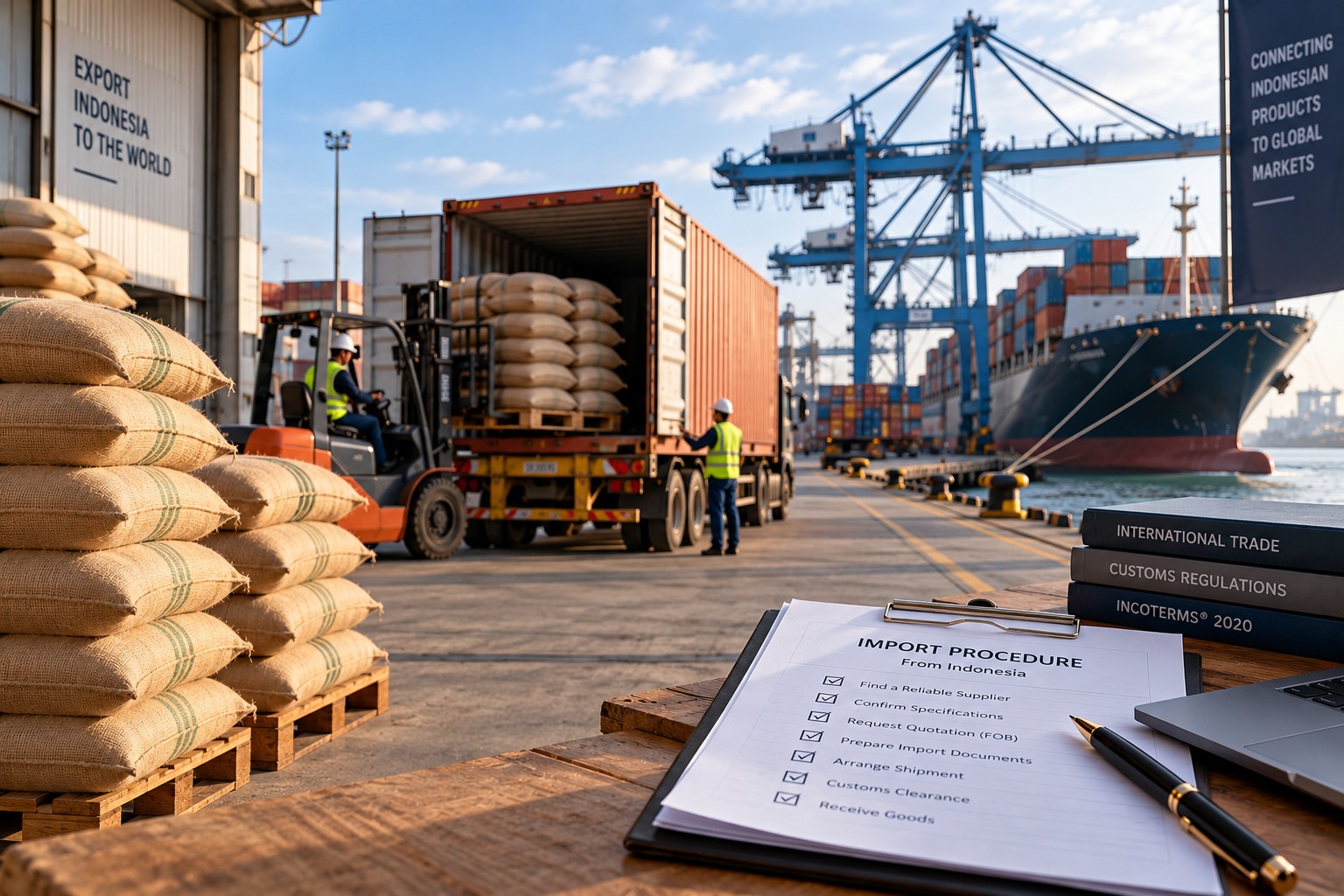
20. A Practical Import Checklist
Supplier & Product
☐ Company registered & verified
☐ Exact origin & crop year confirmed
☐ Screen size & defect thresholds agreed
☐ Moisture confirmed ≤ 12.5%
☐ Pre-shipment sample approved
Commercial & Logistics
☐ Incoterm & loading port confirmed
☐ 20ft FCL bag count & weight agreed
☐ Sales contract executed
☐ PEB, Invoice & Packing List filed
☐ Bill of Lading, COO & Phytosanitary issued
21. Frequently Asked Questions
Can international roasters buy green coffee directly from Indonesia?
Yes. International buyers can procure container-scale shipments directly through licensed Indonesian exporters who handle local sourcing, inland logistics, quarantine inspection, and export customs clearance.
What is the standard minimum order quantity (MOQ)?
For containerized maritime freight, the standard commercial MOQ is one 20-foot full container load (20ft FCL), carrying roughly 18 to 19.2 metric tons (300–320 bags). Consolidated LCL orders can also be coordinated for specialized trial roasting programs.
What documents are strictly required to export green coffee from Indonesia?
The standard export documentation packet comprises: the official Indonesian Customs Export Declaration (PEB), Commercial Invoice, Packing List, Clean on Board Ocean Bill of Lading, Certificate of Origin (Form ICO), and Phytosanitary Certificate.
Can Indonesian Robusta be legally imported into the European Union?
Yes. Indonesian Robusta is regularly exported to European ports (such as Hamburg, Rotterdam, and Genoa). Buyers must ensure compliance with EU plant health rules, pesticide residue ceilings, and deforestation-free traceability documentation.
How do I request a formal quotation from Nusantara Global Trade?
Send your procurement brief—including target grade, required volume, destination port, and preferred Incoterm (FOB/CFR/CIF)—to our commercial desk. We will provide lot availability, technical specs, and competitive pricing.
Ready to Import Indonesian Green Coffee Beans?
Nusantara Global Trade supplies verified Indonesian Robusta green coffee beans from Central Java for importers, roasters, and distributors worldwide. Contact our export desk today to discuss product specifications, request pre-shipment samples, or receive a formal container-load quotation.